How to Reduce Complexities in Software Product Development?

Ever wondered why software development feels simple at the start but becomes complex as projects grow? Many businesses have faced this problem, and studies show that over 66% of software projects run over budget or behind schedule due to rising complexity. This results in delays and frustrated teams also increases costs.
The good news is that complexity can be reduced with smart work and improve software development efficiency. Businesses can make a difference by following the best practices in software development and eliminating challenges that come their way. This will accelerate the development process to ensure faster delivery of products and utilize monetary resources in a desired time frame.
Let’s dig deeper and understand why software development complexity arises, it’s types, ways to tackle it, and streamline operations in your business.
What is Software Development Complexity?
This basically refers to software development challenges that are making the current process difficult to execute. However, numerous contributing factors may cause software development complexity which including the number of components, their algorithms, interactions used, and many more.
Types of Software Development Complexity
Developers often face challenges during the software development process. Each one brings a new set of difficulties to tackle, which needs to be addressed before the final launch day of the product.
Let’s take a look and understand the complexities that occur during the software development process.
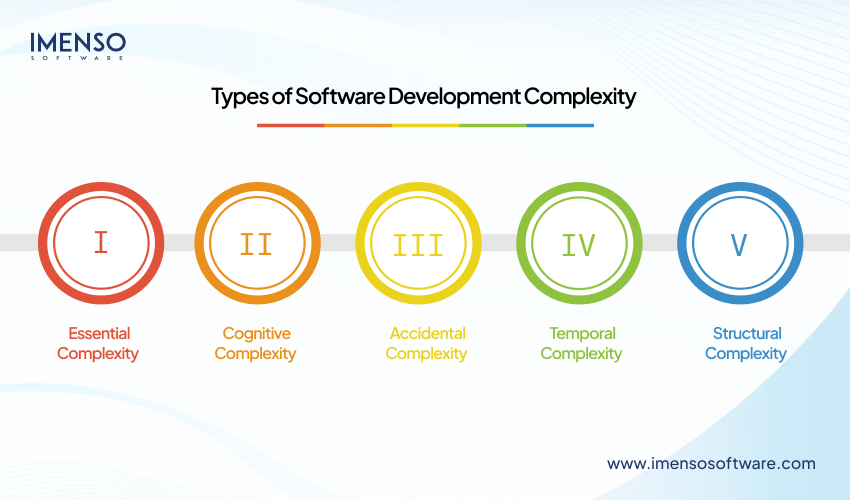
1. Essential Complexity
This is an intrinsic difficulty in solving the problem that a product intends to solve. For instance, consider issues in processing data or in developing algorithms for an artificial intelligence software.
This might sound tough to manage, but can be handled by:-
- Breaking down the problem into smaller components that are manageable.
- Use appropriate special expertise
- Look forward to outsourcing software development services
2. Cognitive Complexity
This type of software development complexity may develop when a solutions are overengineered. Sometimes, overly complicated logic, non-intuitive designs, or nested structures make developers feel overwhelmed. You can reduce the burden by:-
- Simplify the code
- Follow a meaningful naming convention
- Ensure clear documentation
3. Accidental Complexity
It happens because of the tools, processes, and systems that you might have incorporated into your software development process. For instance, you can consider those poorly developed environments, improperly integrated tools, and bad workflows that can bring unwanted challenges. You can eliminate the issues by:-
- Choosing the right tools
- Keeping the databases clean
- Streamlining software product processes
4. Temporal Complexity
This is related to the concerns that are associated with time. It includes finishing the project in the desired timeline, managing phased releases, and synchronizing efforts. Therefore, these multiple timelines and dependencies often create complexities when not handled properly.
5. Structural Complexity
Suppose your product architecture and UI/UX design are improperly designed. This may lead to structural complexity in the software product development, which leads to difficulty in scaling a product, maintaining, and optimizing. All this is because of complex system interactions, tightly coupled modules, and poorly designed architecture. However, you can reduce it via:-
- Design patterns
- Modular architectures
- Focus on making your modules scalable
How to Identify Software Development Complexity in Your Product Building Process?
Ensuring your product’s success and maintainability largely depends on your own efforts to spot potential elements that can lead to any software development complexity. This helps you fix the issues even before they become a major concern in your product.
Here is how you can get to know if your product has any complexity:-
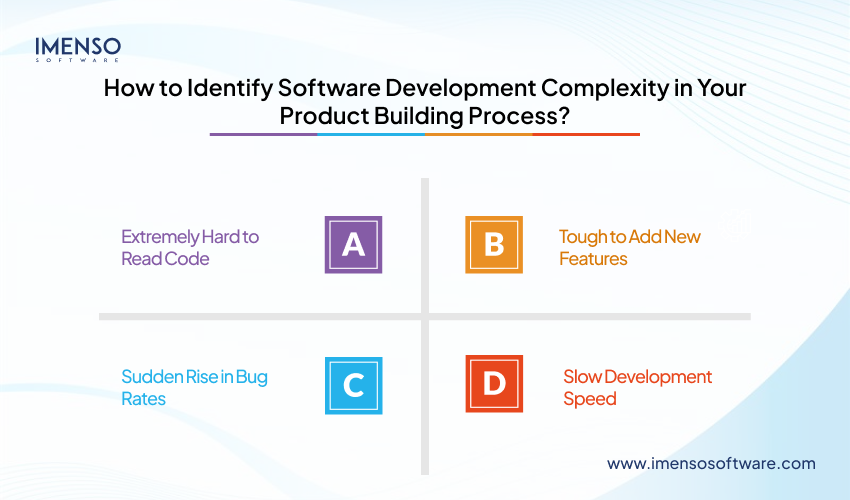
1. Extremely Hard to Read Code
Read your code, and if you find that it is very hard to read even for you, it clearly means it is complex and you need to fix it. This may include overly convoluted logic, inconsistent naming conventions, a lack of comments, etc., that might confuse other developers who will read your code while working on the product.
As a result, the software development process may face difficulties. In fact, this also discourages collaboration and causes extended time when you want to incorporate more members into a project.
2. Tough to Add New Features
For instance, your code writing is completed, and now, as per the evaluation of the initial development design, you have decided to incorporate new features. Suddenly, you discover that it is not easy to integrate new/essential features or causes trouble in the other part of the system in your existing product. This is a clear sign that your existing code base is flawed or poorly written, which might cause issues during the adaptation or evolution of your product as per the user demands in the future.
3. Sudden Rise in Bug Rates
Testing is an important part of the product development process; therefore, it is essential to make sure you implement every phase of the software building process very carefully. However, if you are still facing an uptick of bugs while you are testing your software or during the deployment process, it indicates that the requirements are unclear or robust in testing, and sometimes overreliance on complex system dependencies.
Even if you work on fixing the bugs each time they arise, developers and users both might feel frustrated while using the product. This may lead to a lack of satisfaction and ultimately not a profitable deal for the business.
4. Slow Development Speed
Complexity can also be spotted in cases where the task completion is taking a longer time. For instance, a task that can be finished in a week is taking more than a month, which indicates that there is a complexity involved in the process of implementation. Besides this, inefficiencies in workflows, improper management of timelines, and a lack of potential to maintain existing systems can also lead to this.
As a result, the workflow of building a product is hampered, which ultimately causes delays in the launch.
So, you need to look for these signs and indicators to identify complexities in your software development process. Early detection would give you enough time to fix the concerns and prevent destructive loss.
Issues to Keep in Mind While Detecting Complexities in the Product
Do you know that managing the complexity of the software development process is essential for your success? Since finding these complexities is not an easy thing, for you can utilize the elements discussed above. So, take a look at these challenges to help teams craft better product development strategies.
1. Lack of Modern Tools and Expertise
When you are evaluating for complexities, you need to make sure that your team has advanced/ modern tools and technologies. You can also use static code analyzers for this purpose.
However, this is not helpful for many organizations as they don’t know how to handle this. Besides this, teams also don’t understand the difficulty metrics of the software in such a scenario, and either look for collaborating with an expert or outsource software development to address all of them.
2. Hidden Complexities That Might Go Undetected
If you are a startup owner or someone who is not well-equipped with the expertise of the software development process, you might face difficulty in spotting any complexities. But, there might be some hidden issues in your software product development, such as:
- Unclear assumptions
- Tangled dependencies
- Poorly written or documented code
To tackle this, you can conduct result reviews and stick to the well-defined structure for the seamless execution of the software product development.
3. Diverted Focus
Every developer has their own skill sets and a unique way of development. That’s why, their approach to seeing software development complexity is also different. This might result in how does a software product should look and how does it actually look.
However, this can be easily managed by defining clear complexity metrics and criteria to evaluate any complexity that may arise in the product development process.
10 Best Practices in Software Development to Overcome Software Product Development Complexity
Thinking of now, how to tackle the software development complexities? Well, there are numerous ways to ensure your product is flawlessly designed and used by various organizations. This helps to ensure that your product is developed smoothly, increases its maintainability, and improves collaborations.
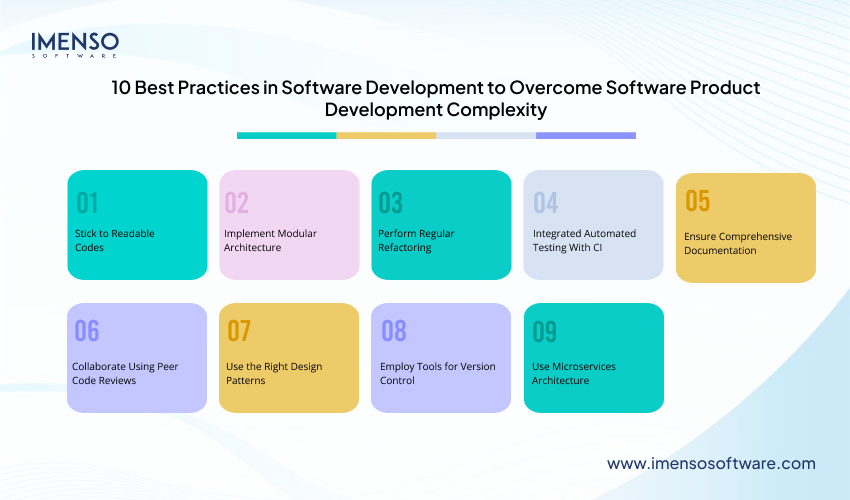
1.Stick to Readable Codes
Want a manageable code base? You should never compromise on having clean code for your software development process. A few tips that you can incorporate are:
- Think and write crisp, concise, and easy-to-read code
- Try to utilize meaningful naming conventions while creating functions, classes, or variables.
- Stick to rational nesting and avoid redundant logics.
2. Implement Modular Architecture
Do you know that optimized resources have a major role in accelerating the delivery of the product? Here are a few steps that you can follow to achieve that:-
- Consider dividing your software into smaller and independent stages.
- Make sure every module has a clear purpose to fulfill.
- Work on reducing interdependencies that might lead to any complexities.
- Manageable modules are always easier to maintain and test in the long run.
3. Perform Regular Refactoring
This is helpful to maintain the code quality and skip the software development complexity. Adopt these steps:
- Try to work on the improved structure and readability of the code.
- In case you find dead code, remove it.
- Streamline all logics that are incorporated and optimize performance.
- Schedule regular reviews for technical debt challenges
4. Integrated Automated Testing With CI
The robust automated testing with continuous integration pipelines helps to eliminate software development complexity. Here are a few ways to avoid it:
- Automate your testing process to detect bugs quickly throughout the development process.
- Make a habit of using CI tools to make sure that new code is integrated smoothly into the system.
- When you detect the issues early, make sure that a clean and stable codebase is created.
5. Ensure Comprehensive Documentation
How often do you maintain documentation of your software products? If you are still not following this practice, then start soon. Create a comprehensive documentation of your architectural designs and your software product development metrics. You can follow these points to do it:
- Make sure that your codebase has clear and up-to-date documentation.
- Try to incorporate explanations for complex algorithms, APIs, and workflows.
- This would smooth the process of onboarding and collaboration between the teams.
6. Collaborate Using Peer Code Reviews
Do you regularly review your code? If not, start doing it to increase your ownership and have a healthy collaboration. Here are the following tactics that you need to use:
- Timely reviewing of work will detect errors and areas of improvement.
- Incorporate constructive feedback and work with your team.
- Try to maintain uniformity and respect the coding standards required.
7. Use the Right Design Patterns
Established design patterns are tried and tested; therefore, they are helpful for the software product development complexity. Here are a few tips to follow:
- Stick to implementing the proven and established design patterns to solve existing development issues.
- Use design patterns to simplify the code structure, such as the observer, MVC, and the Singleton
- Choose to prefer a robust framework to make sure you structure and scale your applications properly.
8. Employ Tools for Version Control
Managing development code might be tough; that’s why tools for version control can be helpful.
- Use Git or tools like that to track and manage versions of code.
- This helps you to go back to the previous code and collaborate accordingly.
- For reference, keep the history of the code modifications of your software development process.
9. Use Microservices Architecture
You should adapt to the micro-services, which help you communicate through APIs. Incorporating DevOps tools helps to simplify deployment and resource use.
- Segregate large applications into small and manageable services.
- Since every service runs independently, it is easier to eliminate the complexity.
- Make the applications scalable to ensure doing targeted updates and fixes.
Tools and Technologies You Need to Use for Better Integration
You probably know that tools and technologies help to optimize the software development process. This will help maintain the simplicity of your product and offer full support to improve code quality. As a result, the product will be robust enough to be managed.
- Modern IDEs: Today’s Integrated Development Environments do more than just let you write code. With features like auto-complete, syntax highlighting, and debugging support, they help developers write cleaner code faster and with fewer mistakes.
- Version Control Systems: Tools like Git act as a safety net for teams. They keep track of every change made to the codebase, making it easier to collaborate, roll back when things go wrong, and understand how the software has evolved over time.
- Static Code Analysis: These tools scan your code automatically, flagging errors, security issues, or deviations from coding standards before they snowball into major problems.
- Automated Testing: Unit tests, integration tests, and continuous integration pipelines help catch bugs early in the cycle—long before they reach production.
- Documentation Generators: Instead of writing endless documentation manually, tools like Javadoc or Doxygen generate it directly from the source code, keeping it consistent and up to date.
- UML Tools: Sometimes, it’s easier to see a system than to read it. UML diagrams give teams a clear, visual representation of architecture, which is especially useful for onboarding new developers.
- Profiling and Performance Analysis: These tools uncover performance bottlenecks and highlight overly complex sections of code, ensuring the application runs smoothly at scale.
- Containerization and Orchestration: Platforms like Docker and Kubernetes reduce deployment headaches by packaging applications in predictable, consistent environments—making scaling and management far less complex.
Why Should You Consider Eliminating Software Development Complexity From Your Process?
Every software project starts with excitement—an idea that promises value. But as the project grows, so does the software development complexity: endless code dependencies, unclear requirements, missed deadlines, and communication breakdowns. Left unchecked, this complexity doesn’t just slow progress; it drains resources, frustrates teams, and increases the chances of failure.
In fact, as highlighted in a 2024 The New Stack article, studies show that resolving issues after deployment can cost up to 30 times more than fixing them during development.
Here’s why simplifying your process matters:
- Faster Delivery: Less complexity means fewer bottlenecks, enabling teams to move from idea to release more quickly.
- Lower Costs: Streamlined workflows reduce rework, wasted effort, and expensive errors.
- Better Quality: When the process is simple, developers can focus on writing clean, maintainable code instead of fighting technical debt.
- Happier Teams: A clear, manageable process reduces burnout and makes collaboration smoother.
- Future-Proof Growth: The simpler your foundation, the easier it is to scale your product as the business grows.
Basically, eliminating software development complexity means building smarter. So, when your development process is efficient, it would motivate your team to put effort to innovate better and increase the chances of success of your product.
Conclusion
The occurrence of software development complexity is not the enemy but a signal that says the product, process, or team has room to grow. Hence, you need not avoid complexity but simplify it in the right ways to make innovation sustainable.
You can think of it like every unnecessary line of code, unclear requirement, or misaligned sprint is a layer of friction. So, you need to strip those layers away with agile workflows, automation, and clear communication. This will ensure that your software delivers real business value faster and smarter.
Additionally, reducing software development complexity isn’t about doing less, but about doing the right things in the optimized order with the correct mindset. Also, if your team masters this will not only build better products but will also outpace competitors in the long run. You can consider outsourcing software development with Imenso Software and work with the experts either for the entire development process or for handling your existing product. Software professionals will ensure to match the frequency of goals you are expecting to align with your product to launch in the market!
Want more information about our services?


Similar Posts

9 Benefits Of Outsourcing PHP Development
You run a web development company, and that’s great. However, you already know how much of a hassle it can be to do everything on your own, including PHP. Thankfully, you can outsource PHP development especially to Indian companies. To convince that you should, let’s discuss a few of the benefits of outsourcing PHP web […]...

The Role of Data in Feature Prioritization: Making Better Decisions
Have you ever had a problem deciding which of the many good features should be implemented in your software roadmap? It remains a challenge for many organizations. In the current world environment user requirements and technological changes are not consistent. A poor decision torments resources and opportunities. Contrarily, a correct decision can enhance user satisfaction […]...

How to Choose the Right Tech Stack for Your Next Software Project?
It’s not about using the trendiest tools. It’s about using the right tools for the job. ~ Inspired by Jeff Atwood, co-founder of Stack Overflow Starting a new software project? You’ve probably heard the term tech stack thrown around. Hence, it is necessary to pick the right one without getting lost in endless options. Don’t […]...