AI in Agriculture Shaping The Future Of Farming
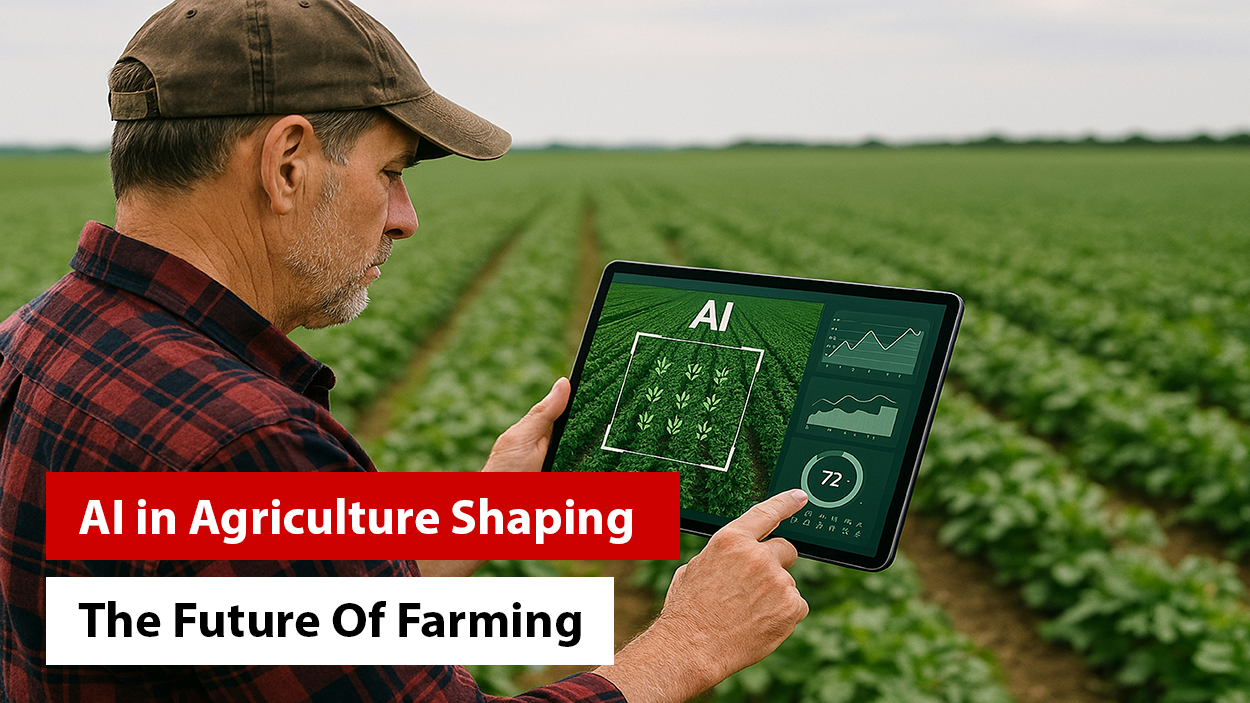
The world is confronted with many pressing challenges. These include an ever-expanding population, climate extremes, and shrinking natural resources. To feed people sustainably, it’s vital to embrace innovative solutions capable of transforming agri-food systems.
The global population will hit 10.3 billion by mid-2080s. By mid-2050, it will reach 9.3 billion. Farming must keep up with this pace by producing over 50% more food than today. But with such problems, how can we make that possible?
Enter Artificial Intelligence.
AI can transform agriculture with powerful new tools. Some examples are precision farming methods and self-operating machines. AI also offers strategic decision-making support to farmers. With the rising population, AI in agriculture isn’t an option. It’s critical to address the challenge of producing more output with less land and labor.
This blog explores the various ways in which AI is reshaping agriculture.
Artificial Intelligence in Agriculture Market (Forecast Period: 2024-2030)
Adoption of AI in agriculture offers various benefits to stakeholders in this sector. Chief among them is real-time monitoring support and enhancement in the quality of harvest. The support from governments has further led to the growth of this industry in recent years.
Below are key market insights.
- AI in the agriculture market is projected to grow at a CAGR of 23.1% from 2023 to 2028. This means that by 2028, it is expected to reach USD 4.7 billion.
- The key players in the AI agriculture market have adopted strategies like product launches and partnerships.
- In North America, increasing adoption of machine learning and computer vision is set to drive the growth of AI.
- During the market forecast period between 2024 – 2030, the software segment is set to hold the biggest market share. Key growth drivers include a higher demand for precise farming and resource allocation.
- Computer vision is expected to grow the fastest in this period. It uses smart algorithms and tech tools to study visual data. Cameras and sensors capture the images for analysis. It detects issues and allows rapid responses to prevent crop losses.
- Precision farming is quickly emerging as one of the leading AI applications in agriculture. It enables farmers to lower expenses and efficiently manage resources.
- Key growth drivers for the U.S AI in agriculture market are the presence of a diverse agriculture industry, the existence of prominent IT companies, and government support through R&D.
- European countries such as the UK, the Netherlands, Germany, and others are increasing their investment in R&D for precision agriculture technologies. The underlying aim is to meet the rising food demand.
- Asia Pacific is set to experience a rapid CAGR from 2024-2030. Key growth drivers include the region’s rising population and higher agricultural productivity demands. Massive investments in agro-tech innovations by governments are another contributing factor.
Why AI in Farming Is Necessary?
Several reasons prompt the use of AI applications in agriculture. In its absence, global agricultural output is vulnerable to severe decline.
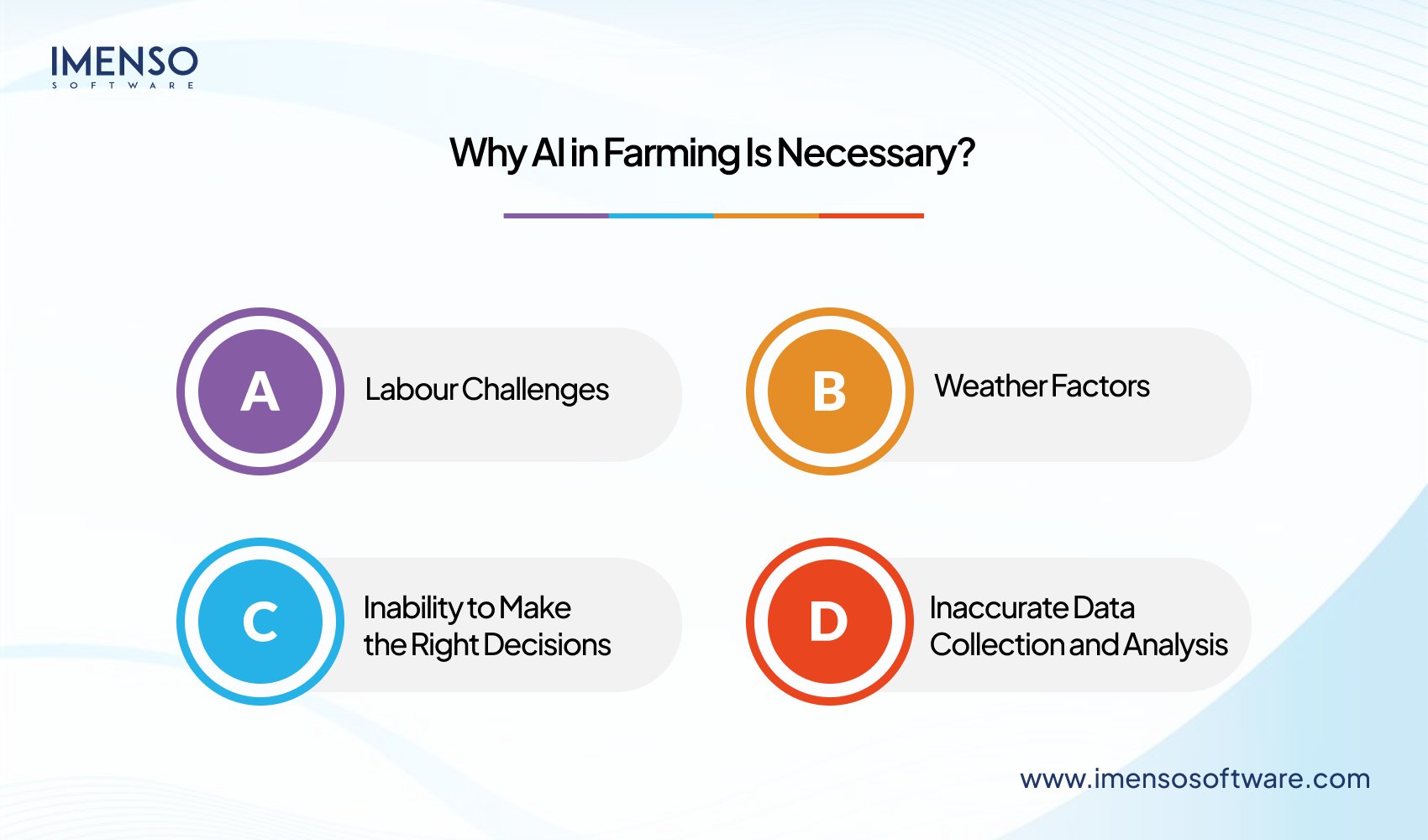
1. Labour Challenges
The agricultural sector suffers from consistent labor shortages. These shortages, driven by various factors mentioned below, will intensify in the near future:
- An increasing number of farmers are reaching the age of 60
- Movement from rural to urban areas
- Less availability of foreign workers due to restrictions on agricultural visas
- Climate change requires the rapid deployment of an adaptive workforce
- Rising labor costs due to higher wage rates for foreign and domestic farm workers
2. Weather Factors
Climate change is causing extreme weather conditions. These conditions threaten the productivity and quality of agricultural output. Rising temperatures disrupt plant growth cycles, photosynthesis, and pollination. Each 1°C increase can slash yields of staple crops by up to 5%. When heat spells strike, they cause higher stress to livestock. It causes a reduction in milk, egg, and meat production.
Further, flooding and unseasonal storms directly lead to crop loss. Other consequences include long-term soil degradation and disruption of farm activities.
3. Inability to Make the Right Decisions
Absence of real-time data has made farmers unable to decide correctly regarding their activities. They cannot find an accurate time for sowing and selecting the best crop varieties for specific fields. AI technology used in agriculture provides field-specific and evidence-based recommendations on time. For instance, AI and sensor-powered systems constantly monitor soil health. They trigger irrigation or fertilizer precisely when and where needed. So, farmers need not depend on calendar schedules. Thus, precision-based agriculture based on data and not experience changes farming into a science-based activity.
4. Inaccurate Data Collection and Analysis
UN’s Food and Agriculture Organization estimates up to 40% annual losses in global crop production due to pests. It translates into a massive blow of $220 billion! Today, climate change and pesticide-resistant pests have turned traditional control methods obsolete. The need of the hour is an approach fuelled by data.
Mobile AI applications in agriculture identify crop pests and diseases. It does so by analyzing photos of crops in real time. Visual patterns are identified and compared against a huge database. Such AI platforms not only generate diagnoses but also suggest precise management techniques. Moreover, farmers get all the information and insights in their native language easily!
The Role of AI in Modern Farming
AI’s role in modern farming is nothing less than revolutionary. Agriculture is set to witness massive growth at a CAGR of 23% till 2028. The agri-food tech landscape in Sub-Saharan Africa has soared to over $600 million.
AI’s role in farming is driven by the following factors:
- A need for more sustainable farming
- Labor shortages
- A rise in costs and food demands
Below are some common AI technologies that help farmers maximize crop yields.
Predictive Analytics
Predictive analytics uses machine learning models and statistical algorithms. Through this, it analyzes past and current agricultural data. Analysis of soil data and weather changes allows this technology to help farmers determine accurate amounts of resources needed. Predictive analytics also helps mitigate risks. It does so by providing early alerts regarding adverse conditions.
Machine Learning (ML)
One of the notable AI applications in agriculture can be seen through the use of ML. Machine learning analyzes huge datasets. This includes past crop yields, soil, and weather conditions. The algorithms spot patterns and correlations that are impossible to manually detect. This helps farmers forecast harvest outcomes.
Computer Vision
Computer Vision is a subfield of AI. It enables machines to understand the visual world like humans. Computer vision applications include AI-driven animal monitoring and visual quality control. Infrastructure monitoring is another common use case. This AI technology used in agriculture massively boosts crop monitoring and growth. It does so by using image analysis to detect growth patterns and plant health.
AI Robots
AI in agricultural robots helps farmers with various activities. Robots can harvest with more accuracy. Not only that, but they harvest quickly in bulk quantities. Networks of robots are used for autonomous livestock farming. They analyze huge data in real time, clean manure, and adjust feeding rations. The data they generate can be analyzed further. It helps determine illness-related inefficiencies.
Offline Agriculture Through Edge AI
AI in agriculture majorly relies on cloud computing. Cloud-only setups combined with
gaps in rural infrastructure prevent real-time, localized decision-making. Edge AI uses machine learning that mimics human reasoning. It reaches the points of user interaction, such as a computer or Internet of Things (IoT) device.
AI Applications in Agriculture
Today, a smart farm uses several AI-based technologies. Below are some of the most common AI applications in agriculture.
AI in Crop Disease Detection
AI can spot trouble in the field way earlier than it can be detected by farmers. Applications detect pests moving in or leaves showing the first signs of disease. That means fewer chemicals and reduced crop loss.
For weeds and insects, AI-powered cameras, drones, and sensors can tell crops apart from pests or weeds. After that, smart tools identify problem spots, so chemical use is done wisely.
Some examples that highlight how AI is used in agriculture for crop disease detection:
- A drone scans a tomato field. It notices a few patches of plants with early blight. The farmer treats just those rows the same day, and does not spray throughout the field.
- A smart sprayer uses computer vision to “see” weeds between lettuce plants. The tool squirts herbicide on just the right places.
- Sensors flag a sudden rise in moth activity in one corner of a cotton field. The farmer places traps there and prevents a larger outbreak.
AI in Pest Control
The shifting climate has led to increasing pest outbreaks. AI offers a great way to stop this phenomenon with better accuracy and efficiency. For instance, automated systems designed with high-resolution cameras and dedicated sensors capture crop images. The data is then used to detect pests and their damage. Machine learning models keep analyzing the images. Then, it classifies pests and assesses their impact.
Many modern AI systems identify invasive species based on heat, sound, and motion. It’s a huge step over manual inspections by farmers that miss early signs. AI data, packed in a user-friendly solution, enables farmers to know the signs that can turn into a big problem later on.
Targeted Weed Management
Computer vision and Machine Learning are two standout technologies for targeted weed control. AI can spot weeds with just two leaves and analyze over 10,000 plant images per hour. These advancements address challenges posed by traditional farming. These include hand-weeding, tillage, and crop rotation. By using advanced technology, farmers can improve efficiency and overcome labor-intensive practices.
AI scrutinizes HD images of fields to differentiate crops from weeds. The platforms have sensors, like cameras and GPS, to precisely identify weeds. For farmers, the most direct benefits of AI in agriculture with these technologies are reduced weed spread, cost, and crop damage.
Resource Management
Proper management of resources has been a challenge for farmers for a long time. The problem arises because of reliance on generalized practices and a lack of timely data. For example, overuse of fertilizers and pesticides not only increases costs but also causes pollution and degraded soil and water quality. Moreover, there are limitations in monitoring large and variable field conditions. This causes over- or under-use of vital inputs like water, fertilizers, and pesticides. As a result, both productivity and sustainability suffer.
AI-based agriculture optimizes resource management in various ways:
- AI applications provide targeted recommendations for nutrient application and irrigation. Thus, farmers can optimize resource use in a way that conserves water and reduces the requirement for chemicals.
- With AI-based crop monitoring and management, farmers boost productivity through improved crop health.
- Data-driven decision support systems by AI offer custom recommendations tailored to the conditions of each farm. These include the type of soil, climate, crop rotation record, and prices in the market.
- AI applications in agriculture assess data on resource use, environmental impact, and compliance. By doing so, these applications identify room for efficiency improvements and waste reduction.
Supply Chain Optimization
Supply chain management in precision agriculture is transforming how food is grown, processed, and delivered. A combination of advanced technologies enables farmers to make informed decisions that benefit both their produce and the environment. These technologies include AI, IoT, and data analytics. With them, farmers can predict demand, optimize supply, and logistics. For example, AI can analyze weather patterns to forecast crop yields. It allows farmers to plan better and reduce losses.
Take the case of Walmart to understand its significance further. The retail giant has partnered with Agritask, a crop supply intelligence company, to enhance the quality of its produce. It aims to maximize the yield and shelf life of sensitive crops like blackberries and cherries by using data analytics and remote sensing technology. It will further lead to reduced food waste and fresher, better-tasting berries.
f. Livestock Health Monitoring
Livestock health monitoring has long relied on labor-intensive manual interventions. Here, the risk of missing critical health indicators was high. Today, advanced image recognition and sensor-based AI systems are fast transforming it. Farmers can now use AI-driven systems to track various parameters. These include feed intake, weight gain, and even emotional health! This occurs with the aid of various sensors and cameras. They gather real-time data. This data is analyzed by complex algorithms.
Below are the chief tenets of AI in livestock monitoring:
- Wearable Sensors: Devices worn by livestock that monitor vital signs and activity levels.
- Camera Systems: Used for tracking animal behavior and health via visual data.
- Data Analytics: AI algorithms that examine gathered data to provide insights and forecasts.
- Automated Feeding Systems: Smart feeders that adjust on the basis of the needs of individual animals.
- Health Monitoring: Early detection of diseases through ongoing health monitoring.
- Behavior Analysis: Understanding animal behavior to enhance welfare and productivity.
- Predictive Analytics: Anticipating future trends based on past data.
h. Pollination By Autonomous Drones
One of the unique AI applications in agriculture is autonomous drones for pollination. These drones help bees that are declining in numbers due to climate change. Today, we are faced with a critical decline in natural pollinators. This threatens global security. Manual pollination is labor-intensive and expensive. AI-based autonomous drone pollination tools are equipped with:
- Specialized micro-drones with electrostatic pollination technology
- AI-powered navigation and flower identification programs
- Accurate pollination algorithms that optimize coverage patterns
- Real-time tracking and analytics dashboard
- Integration with farm management platforms
- Weather-resistant design for longer operation windows
Below is the impact of autonomous drones on farming
- Significant in the pollination success rate
- 6x quicker than manual pollination
- Decrease in pollination costs
- Coverage of 2 acres/hour per drone
- Higher crop yield
- Less dependency on seasonal pollinators
- No chemical use and less environmental impact
The Role of Edge AI in Farming Efficiency
The numerous applications of AI in agriculture will be successful only when there is sufficient connectivity. A significant share of rural communities still lacks basic broadband. It means that farm AI must work offline and make decisions at the edge, not just in the cloud.
Edge AI combines edge computing and AI. It further evolves the concept of edge computing, which is collecting, processing, and managing data locally at the level of the device. Edge AI uses machine learning that mimics human reasoning. It reaches the points of user interaction, such as a computer or Internet of Things (IoT) device.
The use of Edge-AI in agriculture has many benefits. It enables farmers to process data locally on farms. So, they can take immediate actions like optimized irrigation, precise fertilization, and livestock monitoring. This raises yields and reduces resource wastage.
The Serket case study is a clear example of the success of Edge AI. This Netherlands-based technology company uses AI and edge computing to improve livestock farming by monitoring animal health in real time. Its Edge- AI system monitors millions of animals across 40 farms. It detects health issues with 95% accuracy. This has helped farmers reduce mortality rates and cut veterinary and feed costs.
Challenges of AI in Agriculture
AI in agriculture has many benefits. However, several challenges also come alongside using this technology.
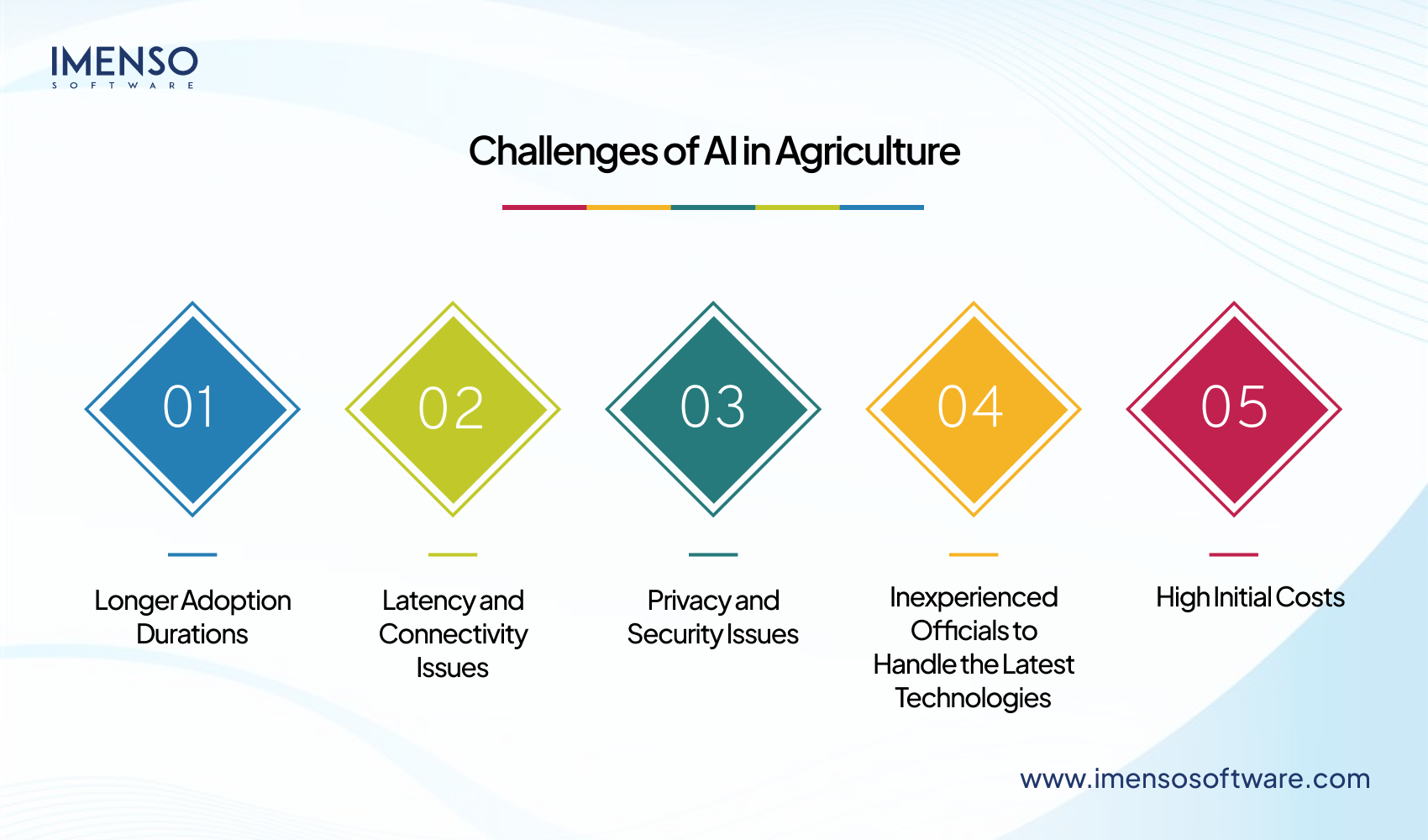
Longer Adoption Durations
The farming community globally has been conventionally resistant to change. But today, this resistance has become a challenge to the adoption of new technologies. Many farmers consider them unreliable and are fearful of their impact on farming practices. Also, AI tools need proper configuration. This, along with the lack of technical proficiency in farmers, delays timely adoption. To overcome this hurdle, more pilot projects, demonstration sites, and real-world successes should be shown to the agricultural workers.
Latency and Connectivity Issues
AI in agriculture majorly relies on cloud computing. Cloud-only setups require continuous internet. Combined with gaps in rural infrastructure, it prevents real-time, localized decision-making. Cloud-based AI setups cause a delay between when data about crops, soil, or environmental conditions is collected and when it gets processed. This latency prevents actionable insights for farmers. They cannot make the needed responses like adjusting irrigation, applying fertilizers, or responding to pest outbreaks.
Privacy and Security Issues
A major privacy and security risk of AI in agriculture is data leaks. This is because it handles an enormous set of information. AI systems are inherently complex. This makes it harder to detect security gaps. So, it is critical for agricultural businesses relying on AI to take care of the privacy and security of their data. It is necessary to create a custom solution to improve the long-term safety of the data.
Inexperienced Officials to Handle the Latest Technologies
There is a lack of people well-versed in implementing AI in agriculture. To implement AI effectively, you must have access to experts who can perform AI-related operations or operate AI tools. The efficiency of these smart systems relies on the input from tech-savvy specialists like software developers. But due to their shortage, businesses face difficulty in implementing and operating AI-based tools.
High Initial Costs
The initial cost of implementing AI in agriculture is quite high. Businesses have to be prepared to shell out a lot of money. This severely restricts the accessibility and benefits of this technology in agriculture. Only the companies with a significant budget can seriously think about reaping the advantages of AI in this sector.
Future of AI in Agriculture
The next phase for AI in agriculture promises many advances. All of them are shaped through recent technologies and research, and the focus will be on sustainability, precision, and resilience.
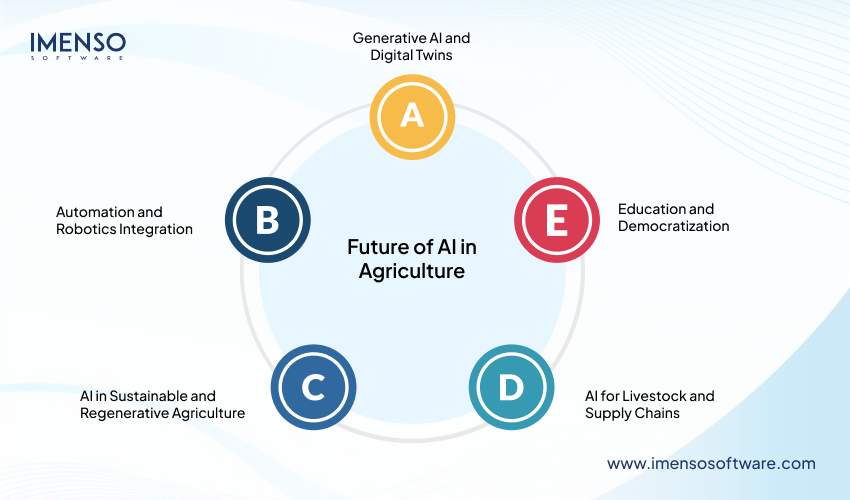
Generative AI and Digital Twins
An emerging trend in AI in agriculture is the incorporation of generative AI and digital twins. Digital twins are virtual replicas of farms. They simulate and predict farming outcomes under various conditions. The direct benefit will allow farmers to test crop management practices. The democratization of AI tools makes these solutions accessible regardless of farm size.
Automation and Robotics Integration
Autonomous machinery, AI-powered robots, and intelligent drones will heighten farming efficiency. These technologies can do the following:
- Conduct seeding
- Targeted pesticide spraying
- Soil analysis
- Harvesting with increased accuracy and less labor.
AI systems keep improving from the data gathered. They can boost productivity to as much as 30% and also reduce labor costs.
AI in Sustainable and Regenerative Agriculture
AI will support the next wave of sustainable farming. The technology will support regenerative practices that restore soil health and improve carbon use. Machine learning models will track soil nutrients, texture, and carbon maps. Thus, farmers can use climate-smart agriculture. Moreover, one of the key benefits of AI in agriculture will come from tech-powered agronomic advice. This will minimize chemical inputs and improve water use efficiency.
AI for Livestock and Supply Chains
AI applications in agriculture will grow in livestock health monitoring. This will happen through computer vision and drone-based surveillance. It will detect atypical behavior and health issues early. AI-driven supply chain management will forecast demand, reduce waste, and optimize agricultural logistics. The result will be better food security and market efficiency.
Education and Democratization
The role of farmers will evolve from manual workers with the increased use of AI in agriculture. They will turn into planners and overseers of smart farms. For this, it is important that they learn IT skills and agribusiness intelligence.
Partner with Imenso Software to Unlock AI-Driven Business Growth
Using AI in agriculture requires a deep knowledge of the technology. At the same time, it’s also necessary to create a strategic implementation approach. At Imenso Software, we help startups create comprehensive technology systems tailored to their agribusinesses. As a leading technology provider, we offer result-driven agriculture technology consulting and custom solutions. From back-end systems to web, desktop, and mobile applications, we offer scalable and flexible solutions. Connect with us today to learn how we can help you.
Frequently Asked Questions
1. What are some real-world examples of AI applications in agriculture?
AI-powered tractors are a notable real-world example of the use of this technology in agriculture. They automate tilling and planting, lowering labor costs. AI agronomic robots give AI-based advice to farmers on crop management. They enable them to make data-driven farming decisions. AI-based disease detection tools are also being increasingly adopted by smart farms.
2. How does AI contribute to sustainable farming practices?
AI platforms analyze data to optimize the use of pesticides, fertilizers, and water. Smart sensors and imaging technologies assess soil conditions. ML models predict weather changes. All this helps reduce waste and minimize environmental impact. At the same time, they improve soil fertility.
3. What are the economic benefits of adopting AI in agriculture?
AI in agriculture offers various economic benefits. AI tools optimize resource management. This reduces costs while boosting productivity. AI-based precision farming techniques result in higher yields. This is done by an accurate monitoring and management of crop health. AI also helps farmers anticipate market trends. This allows them to make better decisions about the right time and place to sell their produce.
4. How can AI help in precision irrigation and water management?
AI-based precision irrigation systems enhance water use efficiency. These tools analyze data from soil moisture sensors. weather predictions and crop water needs. Through this, they optimize irrigation schedules. It ensures that crops get the right amount of water when they need it.
Want more information about our services?


Similar Posts

Deeply Bound to Produce Qualitative IT Products, Imenso Software Justifies Why their Customers Trust their Products: GoodFirms
When client-centric development solutions are needed, Imenso Software always stays on top to serve its customers. Jimmy Kamboj, the founder and CEO of Imenso Software, shares its transformation story with us from a small enterprise to a top IT service provider. Specialized in delivering hi-tech solutions through its unique consultative approach, Imenso Software was established […]...
What Are NFTs And How Do They Revolutionize Digital Art?
On 11th March a painting by Beeple – an American digital artist sold for $69 million at Christie’s. Since then NFTs is the new mystery term that everyone is interested in. a lot of you are confused as to how NFTs are created, how they work and how can someone earn from them? And where can you […]...

The Rise of Remote Dedicated Developers: How to Build a Global Tech Team
Two decades ago, Watts S. Humphrey, the father of quality in software, made a trendy statement. “Every business is a software business.” Humphrey’s view was certainly prescient. Fast forward to the present, Satya Nadella, CEO of Microsoft repeats the same message. “All companies are software companies.” Evidently, businesses in various sectors need efficient software solutions. […]...