How to Choose a Software Development Company: A Step-by-Step Guide
Picking the right partner for your custom software project is a game-changer. It’s not just about finding coders—it’s about choosing a team that gets your vision and delivers without headaches.
Too many businesses jump for the affordable option, only to end up with flawed software and blown budgets. With thousands of firms out there, how to choose a software development company can feel like a maze.
This guide breaks it down with a clear, step-by-step plan to find the perfect custom software partner. Ready to dodge costly mistakes and build software that drives your business forward? Let’s jump in!
Key Steps to Select the Right Software Development Company for Your Project
Developing the right software requires a good team that understands your needs and offers expertise to build top-notch solutions. However, finding such a team can be a headache without proper planning and a roadmap. Hence, we have listed a few steps below to find the best company to develop your software.
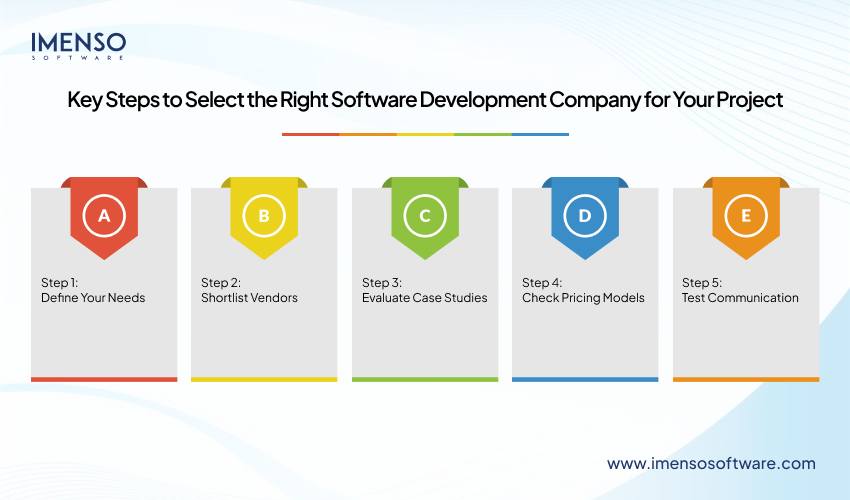
Step 1: Define Your Needs
This step involves identifying your requirements and listing them for better clarity on your goals. Additionally, it helps you remain on equal terms.
Technical Requirements Documentation
Exceeding in your software development project starts with crystal-clear specs. When figuring out how to choose a software development company, a solid technical requirements document is your roadmap. Define your platform—web, mobile (iOS/Android), or cross-platform.
Pick your tech stack, like Python or React, to match your vision. Spell out integration needs—APIs or CRM connections—to keep systems in sync. Set performance goals: fast load times, 99.9% uptime. Don’t skimp on security; outline data protection and compliance like GDPR or HIPAA.
Plan for scalability to handle user growth or global expansion. Prioritize features using the MoSCoW method—must-haves first, nice-to-haves later. Clear specs ensure your software development requirements align with the right partner’s skills.
Business Requirements Clarification
Embarking on a software project with no objectives in mind is like driving in the dark. In searching for a software development firm, begin by explicitly defining your business requirements first. Establish boundaries—launch schedules, milestones, and timing in the marketplace—to keep all parties in sync. Specify your budget, including overall expenditure, payment frequencies, and upkeep expenses.
Identify who’s on board—your stakeholders, decision-makers, and tech crew—to simplify working together. Target business goals: revenue growth, user expansion, or productivity improvements. Set KPIs, such as conversion rates or uptime, to gauge success.
Finally, clarify your risk tolerance—favor proven tech or chase cutting-edge innovation? Clear software project requirements ensure your chosen partner delivers exactly what your business needs.
Vendor Capability Requirements
Choosing the right partner to select a software development firm starts with knowing what you need. Want startup agility or enterprise stability? Small teams move fast; bigger ones offer robust resources. Consider geography—time zone overlap and language ensure smooth chats, while cultural fit keeps things comfy.
Industry experience is key; a healthcare app needs regulatory know-how, unlike retail. Don’t overlook post-launch—top firms provide ongoing maintenance, updates, and support for new features. Check their team setup: dedicated crews mean focus, while shared resources can be stretched thin. Pick a firm that matches your vision.
Step 2: Shortlist Vendors
The second step involves scrutinizing the vendors you have selected for your project. By evaluating each of these vendors, you can find out the best-suited option.
Research and Discovery Methods
Finding the perfect partner starts with smart research. When figuring out how to choose a software development company, dive into industry directories like Clutch.co and GoodFirms, with verified reviews.
Tap LinkedIn for recommendations or ask peers at tech conferences for referrals. Check a company’s online presence—great websites and insightful blogs signal expertise. Social proof, like client testimonials and case studies, shows their track record.
Consider geography: local, nearshore, or offshore impacts communication. Look for firms with years of experience that have worked with projects on similar industries as yours. Start your software vendor research here to find a startup software partner that nails your needs.
Preliminary Vendor Assessment
Your hunt for a software development company should start by assessing different vendors to make a choice, check their portfolio. Look for projects matching your complexity, industry, and tech stack—like a healthcare app using React.
Verify company stability: business longevity, team size, and client retention are indicators of dependability. Technical certifications, such as AWS or Microsoft affiliations, indicate proficiency. Process maturity is important—Agile/Scrum certifications and ISO compliance guarantee orderly execution. Assess communication: excellent English, time zone compatibility, and fast turnaround maintain fluidity.
Demand pricing transparency—clear rates and estimates avoid surprises. Finally, check team composition: balanced developer-to-manager ratios and senior talent drive success. This software vendor evaluation sets you up for a winning custom software partner.
Shortlisting Criteria and Framework
Nailing how to choose a software development company starts with a smart shortlist. Use a weighted scoring system—30% technical fit, 25% experience, 20% cost, 15% communication, 10% culture—to rank vendors.
Aim for 5-7 vendors for a deep dive; it’s manageable yet thorough. Request standardized info for fair comparisons. Keep research to 1-2 weeks, and align your team on the shortlist before moving forward. This software vendor shortlisting sets you up for success.
Step 3: Evaluate Case Studies
Case studies are useful to discover the strengths and weaknesses of a particular vendor. This helps you make the right decision.
Case Study Analysis Framework
Digging into case studies is key to choosing a software development company. Look for projects matching your industry, complexity, and tech needs. Check how they tackled challenges with innovative solutions. Review their architecture, tech choices, and scalability plans.
Quantifiable wins—like 30% faster performance or 2x user growth—show real impact. Assess timelines for delivery reliability and team structure for expertise balance. Look for glowing testimonials and repeat clients. Finally, ensure their projects thrive post-launch with solid maintenance. This software vendor case study approach picks winners.
Red Flags and Warning Signs
When you choose a software development company, watch for dealbreakers. Generic case studies with vague details or no clear results scream trouble. Outdated portfolios—think projects from 2019 using obsolete tech—are a hard pass. If they dodge sharing references, citing “confidentiality,” run.
Look for patterns of scope creep, like constant budget overruns or missed deadlines. Surface-level pitches lacking technical depth or missing post-launch data—like maintenance or growth insights—are red flags. These software vendor red flags can tank your project, so steer clear.
Validation and Verification
When figuring out how to choose a software development company, don’t skip validation. Chat directly with their case study clients to confirm their claims. Dig into technical details—ask for code quality reviews, performance tests, or security audits.
Request live demos of working apps to see user feedback and metrics in action. Verify key team members actually worked on showcased projects. Check if timelines match reality and use third-party tools to confirm outcomes, like user growth. Solid software vendor verification ensures you pick a winner.
Step 4: Check Pricing Models
Different software development companies have different pricing methods. By understanding the different pricing models and what they offer with each of them enables you to make an informed decision.
Pricing Model Understanding
When figuring out how to choose a software development company, pricing models are key. Fixed-price projects suit clear scopes, with 20-30% higher rates but less risk. Time-and-materials offers flexibility with hourly billing—think $25-$50 for juniors, $80-$120 for seniors—but needs tight project management.
Dedicated teams, with monthly costs, give you full resource control for long-term gigs. Hybrid models mix approaches for phased projects. Rates vary: US ($100-$200/hr), Eastern Europe ($40-$80/hr), Asia ($20-$50/hr). Watch for hidden costs like setup fees or tools. Pick a model that fits your budget and goals for smart startup software budgeting.
Total Cost of Ownership Analysis
When you choose a software development firm, think beyond the initial price tag. Development costs cover planning, design, coding, testing, and deployment. Post-launch, expect maintenance (15-20% of development cost yearly), hosting, and monitoring expenses. Scope changes or new features add up, so clarify rates upfront.
Ask about bug fix periods and ongoing support SLAs. Factor in training, documentation, and knowledge transfer for your team. Long-term partnerships with retainers can secure priority support and discounts. Mitigate risks with insurance or escrow. Use an ROI framework—payback period and break-even analysis—to ensure your custom software TCO delivers startup software ROI that grows your business.
Step 5: Test Communication
Seamless communication is key to successful project development and delivery. Evaluate the communication skills and methods of your vendor before choosing them for your project.
Communication Assessment Methods
When you select a software development partner, communication is make-or-break. Start by gauging their response time—24-48 hours is standard—and how thoroughly they address your questions.
During technical interviews, assess their problem-solving and tech recommendations. Discovery sessions reveal their knack for nailing requirements and spotting assumptions. Their proposal should be clear, with realistic timelines and transparent costs. Meet the team—check key players’ availability, English skills, and cultural fit.
Ensure they’re fluent in tools like Slack or Zoom and familiar with project platforms. Review their documentation—sharp specs and progress reports signal reliability. Strong software vendor communication builds trust and drives your project to success.
Project Management Capabilities
When you select a software development partner, project management is the glue that holds it together. Look for teams rocking Agile/Scrum with slick sprint planning and retrospectives. Expect daily standups, weekly reports, and clear milestone reviews.
Issues? They should spot problems fast, resolve them smoothly, and keep you looped in. Scope changes need clear approval workflows. Quality assurance—think rigorous testing and code reviews—ensures a polished product. Choose a partner with solid software project management to nail your project.
Cultural and Working Style Fit
In order to choose the right software development company, cultural fit is key. Ensure time zones align for easy meetings and real-time collaboration. Check if their communication vibe—direct or detailed—matches yours.
They should adapt to your processes and handle urgent requests smoothly. Look for a team that builds long-term relationships and grows with you. Conflict? They should resolve issues professionally, ensuring your startup software fit drives success.
Conclusion: Your Path to the Perfect Software Partner
To select a software development company assess risks—technical, financial, operational—and allow a week for stakeholder alignment. For big projects, consider a pilot to test the waters. Define KPIs to track vendor performance and keep a backup vendor ready.
Ready to build your dream software? Imenso Software is a reliable software development company with years of expertise, impressive ratings on Clutch and GoodFirms, a strong portfolio, and a lot of appreciation from our clients, reflected in our success stories.
As a well-established company that has served businesses ranging from startups to Fortune 500 brands, we are the best fit for your project with our proven deliveries.
Ready to build game-changing software? Imenso Software is Your Reliable Partner.
Frequently Asked Questions
Q1. Why do most software projects fail when selecting the wrong partner?
Because the wrong partner equates to mismatched talent, poor communication, and ill-defined priorities. Research indicates that approximately one out of every three IT projects fails because of poor vendor alignment. When your team is not “on the same page” in understanding your vision, the outcome is buggy software, runaway costs, and delays that suck budget and morale both.
Q2. How do I know a software development firm is right for my project?
Seek alignment, not only skill. The best partner goes beyond tech skills to dig deep into your objectives, ask intelligent questions, and exhibit a portfolio with comparable projects. Beyond technical abilities, they must demonstrate reliability—good communication, open pricing, and long-term care. If they “click” on your business vision, you’re headed in the right direction.
Q3. Do I use the lowest-cost software development firm to save money?
Short answer—no. The low cost usually ends up being the most costly blunder. Low-cost providers skimp on work, which causes buggy code and constant rework. Instead, consider value: a partner who produces high-quality software on time, grows with your business, and keeps you out of trouble in the future. It’s an intelligent ROI, not merely cheap bills.
Q4. How significant are case studies when selecting a vendor?
Case studies are your view into how an organization behaves when the stakes are real. They reveal how vendors handle issues, manage deadlines, and get results. Search for quantifiable results—such as faster performance or greater user adoption—not merely warm and fuzzy guarantees. A solid case study assures you they’ve done it previously and can do it again.
Q5. How important is communication to a successful software project?
Massive. Even the best developers can kill a project if they are not good communicators. Frequent updates, transparent documentation, and rapid reply keep everything on the same page. Good partners don’t simply “build”; they work together, learn, and keep you in the loop from kick-off to launch. Communication is the glue that keeps your project sticking together.
Want more information about our services?

Similar Posts

Google Cloud vs. AWS: A Comparison of Cloud Computing Services
Are you currently navigating the intricate cloud computing landscape, pondering which industry titan – Google Cloud or Amazon Web Services (AWS) – holds the key to unlocking your business’s true potential? Fear not, for we are here to guide you through this compelling journey of exploration and comparison. In today’s dynamic business environment, cloud computing […]...

How to Get Started With Hybrid Mobile Application Development?
Whether you have the next big business app idea. Or you have an idea to develop your business app. In any case, you’re required to choose between hybrid mobile app development and native mobile app development....
Signs You’re Ready to Outsource Software Development
A recent survey on global outsourcing by Deloitte revealed that over 70% of companies outsource IT activities. The most commonly outsourced functions are UX/UI design, QA, and coding. Outsourcing of software allows businesses to streamline operations. It also facilitates better use of in-house talent in core activities. Software outsourcing today has become a necessity for […]...