How Offshore Engineering Teams Help Enterprises Scale Quickly

Balancing daily tasks while aiming for growth is an arduous challenge for businesses. But what if there’s actually a way to overcome this hurdle and scale faster than you could have ever imagined? Offshore engineering teams help you do exactly that.
Offshoring not only saves costs but also boosts efficiency and productivity. All of it gives your business the freedom to scale rapidly.
The global offshore development market was set to reach $178.32 billion in 2025. By 2033, its value will more than double. Key reasons behind this rapid growth are:
- Reduced development expenses
- Access to a vast, global pool of talent
- Ease of scalability with little internal pressure
- No administrative burden
- Shorter time to launch
Let’s find out how offshore teams help streamline operations, enabling businesses to scale faster than they could ever imagine.
The Scaling Challenge for Enterprises
Businesses face several hurdles that dampen their rapid growth, signaling a need for an offshore engineering team, the chief among which are:
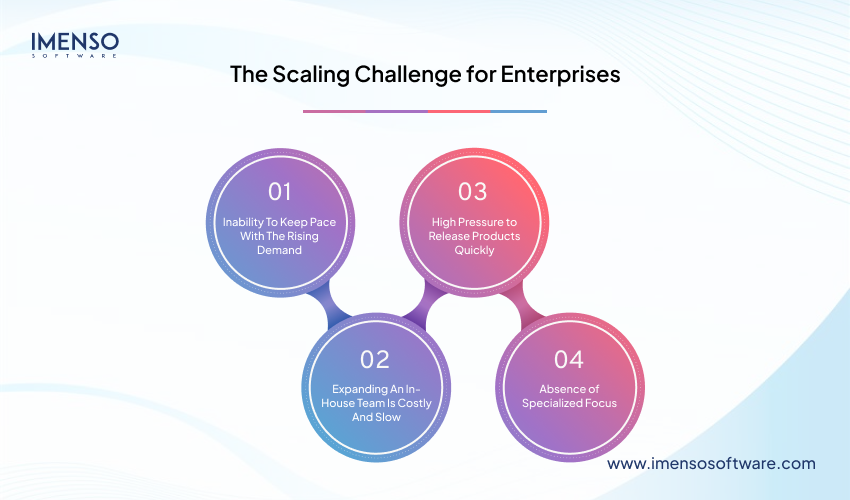
1. Inability To Keep Pace With The Rising Demand
Changing customer preferences and a limited local talent pool prevent enterprises from growing sustainably. In the presence of limited existing production capacity, businesses rush to complete orders. The effect is seen in decreased quality and negative customer experiences.
Also, the attempt at internal scaling creates administrative and operational overhead, but without adequate talent and budget, providing high-quality services is almost impossible.
2. Expanding An In-House Team Is Costly And Slow
The decision to expand the in-house team costs more than just salary. Expenses in benefits, payroll taxes, onboarding, training, and infrastructure also need to be considered. Don’t overlook the fact that hiring the best-fit employees can take a long time. Weeks and months can go by, and yet you may not find the ideal person for the required role. All this slows down scaling.
3. High Pressure to Release Products Quickly
Rapid release cycles in a bid to take over market share have more consequences than rewards. It often causes operational chaos wherein your processes are beset by the quick pace. The result is missed orders, delays, and complaints by a majority of customers. The pressure to expand also leads to cutting corners on quality and testing. It decreases the final product’s reliability and hurts customer trust. Often, it culminates in technical debt. Technical debt is rework due to choosing an easy way at present instead of a better method that would take longer.
Also read: How to Reduce Technical Debt in Rapidly Growing Startups?
4. Absence of Specialized Focus
Investment in new initiatives requires specialized knowledge. Without people who possess it, struggles to meet new demands are guaranteed. For example, you need to launch an AI-powered chatbot for better customer service. If there’s no one experienced in AI chatbot development, your project will be prone to mistakes and delays.
What Offshore Engineering Teams Offer
Offshore engineering teams help enterprises bypass growth walls. They provide quicker access to specialized talent with highly flexible contracts. So, you don’t need to deal with talent limitations in your area. You can instead meet the rising demands and changing preferences of your clients.
With an offshore engineering team, you can manage load peaks without straining your budget. The experts are capable of intervening in technologies your in-house team hasn’t mastered yet. They even strengthen your technical teams when you cannot recruit the profiles you need the most. Offshore teams focus solely on your project without disrupting any other initiatives. It creates a predictable development cycle, which can be modified as per new suggestions.
Benefits of an Offshore Team for Scaling
An offshore team of engineers significantly reduces the distance between the current state of a business and its growth potential. Here’s how.
Cloud Migration and Modernization Projects
You can hire offshore developers who have specialized skills in cloud computing, migration, DevOps, and related technologies. Thus, modernizing legacy systems quickly becomes easier. Working with offshore teams in varied time zones allows for all-day progress. Continuous work cycles (CI/CD automation and monitoring) quicken cloud migration sans added risks.
Enterprise App Development and Maintenance
Enterprise applications are complex and highly customized. Apps for ERP, CRM, and BI that support core operations demand expertise in many areas. An offshore engineering team has seasoned developers for building them. This includes front-end and back-end developers. It also comprises experts in DevOps, QA, and cybersecurity. You’ll also get full-day support. So, your business can meet dynamic customer needs.
Large-Scale QA and Testing Operations
In-house scaling of the QA department can be costly and slow. Offshore QA teams are able to handle testing for software of any complexity. They bring proven frameworks and tools for testing across platforms and regions like
- Agile Testing
- Test-Driven Development (TDD)
- Behavior-Driven Development (BDD).
Enterprises can benefit from thorough manual testing services or automated QA testing for a supercharged development process. Moreover, there is constant support from account managers of the offshore engineering company. The consistent communication and help keep the project on track.
AI/ML Model Development and Deployment
Accessing specialists in AI/ML has conventionally been tough. But offshore software development services make it easy. They provide you with teams of AI/ML engineers who have a wide range of experience in building scalable solutions. There’s no need to doubt their capabilities, as the offshore development company selects professionals pre-vetted for core AI skills with a proven track record of using them.
You can benefit from their services in many ways. Be it consulting for an AI-driven future, compliance with AI governance, or speeding up proof-of-concepts, they provide tailored assistance.
Startups Scaling to Enterprise-Level
Consider a fintech startup that suddenly gets a substantial banking partnership. To meet increased demand, it must upgrade its app and combine safe payment APIs with it. The next step would be to quickly run compliance testing across all regions. All this needs more specialized manpower and resources. With offshore teams, this gap can be easily met. The quick access to developers, QAs, and DevOps simplifies the task of meeting enterprise-level demand. So, startups can grow sustainably without sidelining product quality in a rush.
Best Practices in Offshoring to Enable Enterprise-Grade Scalability
Want to scale offshore engineering successfully and avoid common roadblocks? These strategies will help.
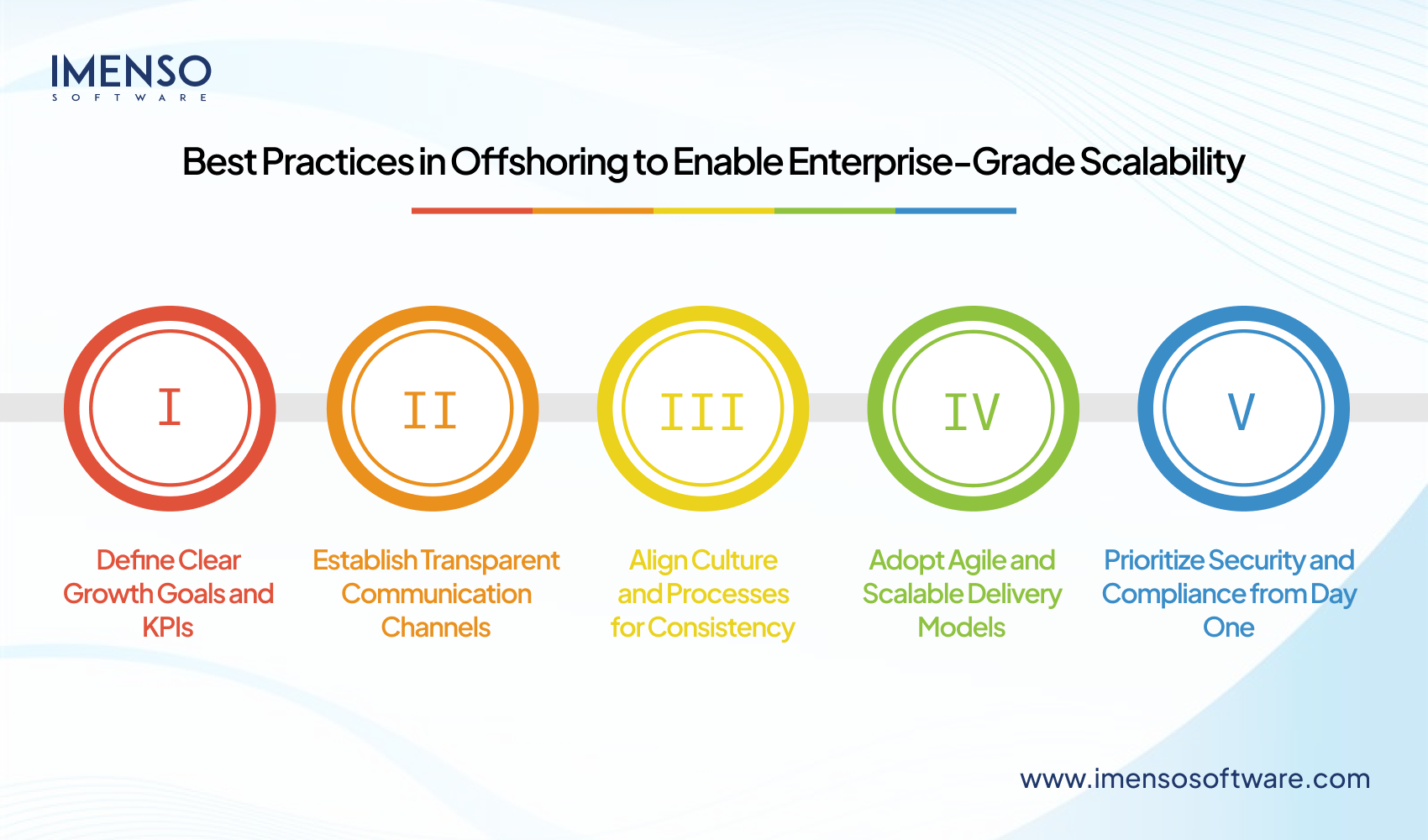
1. Define Clear Growth Goals and KPIs
A spaceship can’t take off without a clear destination and a system to track its progress. Similarly, to scale with the help of offshore teams, begin with extremely clear goals that you can measure. If you aim to speed up product releases, set a concrete goal to reduce release cycles from six to three weeks. If you plan on launching complex features, make it your major objective.
At the same time, your goals should be in line with your KPIs. KPIs are like the gauges that show if you’re on track or not. For example, to double the deployment of new features every quarter, track the percentage of features completed on time. Also, assess their impact on customer satisfaction. This practice changes your offshore team from a far-flung resource to a focused and accountable partner, a partner that supports your growth.
2. Establish Transparent Communication Channels
Even the most talented professionals fall out of sync without structured processes. So, if your offshore team cannot access tools for the same tools, your project’s progress will reduce. Tools for project management, chat, and visibility, like dashboards and messaging apps, are key to smooth information flow.
Transparent communication channels give leadership ongoing insight into offshore operations. There is no need for micromanaging every task. Dashboards showing KPIs, release dates, and quality metrics let executives steer the ship confidently. It helps with scaling teams and projects without letting go of performance.
3. Align Culture and Processes for Consistency
Your customers everywhere expect top-class service. To achieve this and grow, it’s crucial to regulate work processes and coding guidelines.
This practice makes sure that every offshore team, be it in New York or Warsaw, gives the same quality of excellent work.
For example, unified coding standards mean developers across regions write clean and compatible code. The code fits logically into the overall product, so the need to rework later on never arises.
4. Adopt Agile and Scalable Delivery Models
Enterprise-grade scalability demands flexibility in a way that doesn’t overpower quality and resources. Agile practices make this possible. Rather than enforcing sudden, big changes, businesses can focus on a step-wise process. Incremental scaling with the Agile approach happens by adding developers, features, and delivery step-by-step.
Beyond this, agile facilitates frequent communication and feedback. Offshore engineers respond swiftly to shifting priorities without stopping progress. Thus, businesses maintain momentum and quality even with expanding scope and tight deadlines. This scalable delivery model allows your processes to grow with your team. Whether you have an offshore group of five or 50 persons, Agile frameworks like Scrum or Kanban give you a flexible way to coordinate and manage work.
5. Prioritize Security and Compliance from Day One
Security and compliance aren’t just an afterthought when you aspire to scale a business. As more moving parts spawn, they create grounds for security breaches or regulatory violations.
When expanding to various countries, you must remember this. Each region has data protection laws. Examples include GDPR and CCPA. If there is no compliance framework, you can violate it while handling customer data. The consequences can range from fines to loss of valuable customer trust.
But if you have a global compliance framework, your business is primed to scale. We are talking about secure data handling processes, audits, and adherence to international standards. So, make security a deep part of your workflows so the offshore teams can operate with peace of mind about their work, meeting rigorous standards.
Future of Offshore Engineering in Enterprise Growth
The future of offshore engineering looks highly promising with trends like hybrid models and technologies like AI. We can expect it to resolve the challenges entrepreneurs globally face. Let’s take a closer look at them.
The Shift Toward Hybrid Engineering Models
Hybrid models consist of both in-house and offshore teams. It’s becoming popular as it allows businesses to tap into local and global tech expertise. They can combine remote and in-site operations. This makes them better positioned to efficiently innovate. Below are the benefits of hybrid engineering models.
- Optimal Division of Responsibilities: The hybrid model allows enterprises to delegate tasks based on teams’ strengths and skills.
- Effective Communication: A portion of the team remains on-site. This helps with maintaining clear, real-time communication channels. It, in turn, lowers the chances of miscommunication in an offshore setup.
- Efficient Project Management: Hybrid development gives managers the ability to oversee hands-on and remote oversight simultaneously.
- Scalability Benefits: A blend of onsite and offshore expertise provides flexibility in scaling up or down based on project needs. It enables businesses to adapt swiftly to market changes without sacrificing quality.
AI and Automation in Offshore Software Development
AI and automation have altered offshore software development. These technologies improve both efficiency and the quality of software products. Here’s how it is changing the way enterprises scale and innovate.
The Impact of AI on Offshore Engineering
1. Improved Decision-Making
AI systems analyze high volumes of data. This enables them to provide insights for better decision-making. For developer offshore teams, AI tools offer valuable information about market trends, audience preferences, and possible risks. This approach helps developers create software that aligns with their users needs. It leads to higher satisfaction rates.
2. Enhanced Project Management
AI-driven project management tools automate routine functions. These include scheduling meetings, tracking project goals, and more. They ensure that projects stay on track and reduce the risk of budget overruns.
3. Predictive Analytics
AI algorithms efficiently assess past data. They then predict future project outcomes. By spotting patterns, the algorithms allow offshore engineering teams to make precise forecasts about their project. These include predictions related to timelines and challenges. This facilitates addressing problems before they turn massive. This improves the project success rates.
4. Quality Assurance Automation
AI-driven testing tools automate the testing process so solutions fulfill the quality criteria. These tools can perform routine tasks more quickly and accurately than human testers. Some examples of these tasks are regression and performance testing. Thus, it lowers human error and quickens testing. This allows offshore teams to quickly deliver quality software.
Automation in Offshore Software Engineering
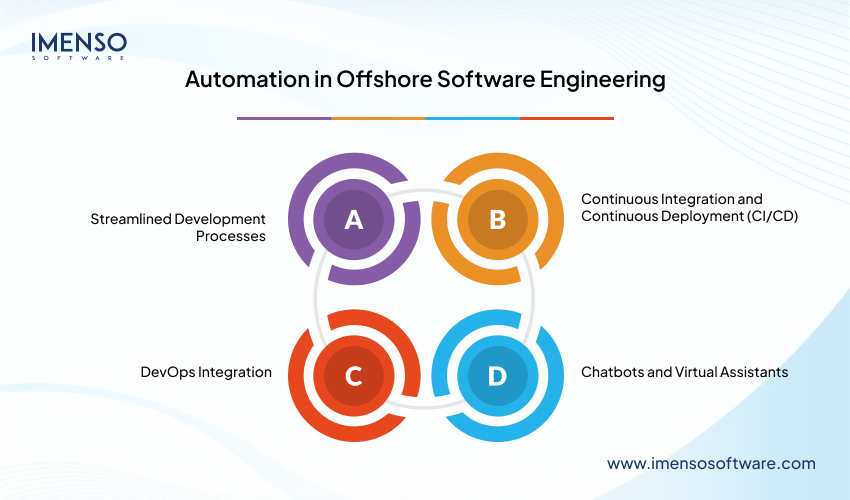
1. Streamlined Development Processes
Automating routine tasks such as code deployment, integration, and more allows offshore teams to focus on more complex tasks. This leads to quicker development cycles and time-to-market.
2. Continuous Integration and Continuous Deployment (CI/CD)
Automation leads to a smooth incorporation of code changes. It also facilitates the ongoing deployment of software updates. With CI/CD pipelines, offshore teams can deliver new features swiftly. This gives clients timely updates without disturbances.
3. DevOps Integration
Automation plays a crucial role in integrating development and operation teams. Automated workflows promote better communication and collaboration. Offshore teams can use DevOps tools to simplify processes. It also ensures that all stakeholders have a common understanding of project goals.
4. Chatbots and Virtual Assistants
AI-driven chatbots and virtual assistants can handle customer inquiries and assist developers in finding resources. By automating these tasks, offshore teams can delegate their human resources more effectively. This leads to a better focus on key aspects of the project.
Long-Term Benefits of Distributed Teams in Driving Innovation at Scale.
Today, success depends on the ability to adapt to customer needs. Enterprises globally are realizing that distributed teams are key to delivering unique and better products. Here’s how they help with scaling.
Increased Efficiency
A recent survey reveals that 77% of developers are more efficient when working from home. Modern communication tools have made collaboration seamless in a remote setup. Because the developers work in separate time zones, more code can be generated.
Cost-Effectiveness
Hiring offshore teams in countries like India lets you save money on salaries. This is due to the cost of living being much lower in these nations.
Lower Churn Rate
The tech industry is very competitive. Enterprises are always poaching talent from their competitors. Developers have endless opportunities. So, software firms have more than an average churn rate. A distributed team reduces this rate. This is because it offers higher flexibility and work-life balance.
More Operational Throughput
With distributed teams, it’s easier to get more done. A strategic structuring of working hours across the time zones gives more operational hours for the company. So, you can offer ongoing services. It also allows you to attend to all development needs whenever they arise.
Diversified Expertise from a Wider Talent Pool
With a distributed team, you can access a wider talent pool. You can hire people with skills that aren’t present in your location. Enterprises that embrace diversity perform better than their peers. People from different cultural backgrounds with different perspectives enrich the development process. They help businesses put forth innovative solutions.
Enhance Your Project’s Success With a Dedicated Offshore Engineering Team from Imenso Software
Offshore engineering gives your enterprise a dedicated team of experts. The approach optimizes development processes, enabling you to rapidly scale. It delivers a higher quality output at lower costs.
If you are looking to hire an offshore software development team, partner with Imenso Software. We serve businesses of all types with custom software development services. Our team of skilled engineers works in close collaboration with your in-house team, ensuring quality and efficiency every step of the way. Connect with us today.
Frequently Asked Questions
- How do offshore developer rates compare to local rates?
Hourly rates for offshore developers fall between $10-$55. This depends on their experience, location, and the type of project. The rates of offshore engineering teams are usually lower than local ones. This is because of the difference in the regional cost of labor. For example, developers in India charge much less than those in Western Europe.
- How do offshore developers integrate with existing teams?
Offshore developers can integrate with the existing team through a structured approach. Creating strong communication channels and providing detailed documentation to close cultural and location gaps. It enables the team to perform their best.
- Is offshoring a complete alternative to in-house hiring?
Offshoring is not a complete alternative to in-house hiring. However, it is certainly a viable one. Offshoring involves sourcing developers globally to perform business operations. This approach reduces costs and gives enterprises access to a vast talent pool.
Want more information about our services?


Similar Posts

Cost to Build a Learning Management System (LMS) for EdTech Startups
Did you know online education is booming — and EdTech startups are leading the charge? Learning Management Systems (LMS) have become the backbone of modern learning, helping schools, businesses, and solo learners build skills anytime, anywhere. With more people craving flexible, personalized education, the LMS market is on track to hit $51.9 billion by 2028. […]...

Google Cloud vs. AWS: A Comparison of Cloud Computing Services
Are you currently navigating the intricate cloud computing landscape, pondering which industry titan – Google Cloud or Amazon Web Services (AWS) – holds the key to unlocking your business’s true potential? Fear not, for we are here to guide you through this compelling journey of exploration and comparison. In today’s dynamic business environment, cloud computing […]...

The Ultimate Checklist for Hiring Offshore Developers for Your Startup
Startups find it difficult to balance creativity and financial barriers. It can be expensive to hire the best in-house engineers. This makes it difficult for startups to grow. Offshore development is a game-changer in this situation. There is a lot of pressure on startup business founders. This is to meet deadlines and budget problems. This […]...