Fitness App Development Guide: Features, Cost Breakdown & Key Steps
A recent McKinsey research reveals something striking. The US is home to the world’s most health-conscious individuals with a wellness market reaching $480 billion! Each year, it grows at a rate of 5 to 10%.
The newer generations, in particular, are investing more in such products and services. Fitness apps constitute a key part of their spending. Apps like Apple Fitness often get many downloads.
The primary driver of higher fitness app usage are:
- They are easy to use.
- You can carry them with you all the time.
- They give you workouts made just for you.
Fitness apps challenge the traditional gym-going model, with fixed schedules and physical presence.
The time is ripe for offering a novel fitness app to a rapidly expanding segment of wellness enthusiasts. However, the market is also saturated. New apps are released every month.
To stand out, you must have a clear vision of your product. At the same time, you must know the cost involved in this undertaking. That’s exactly what we will cover in this guide.
Trends in the Fitness App Market: Your Golden Ticket to Success
Things come and go in the fitness app sector. You might have an idea, but so do others. How do you ensure that yours achieves success?
By spotting trends.
Identifying trends in fitness mobile app development and harnessing them will help you create what people really need.
Let’s look at what is raging in this sector.
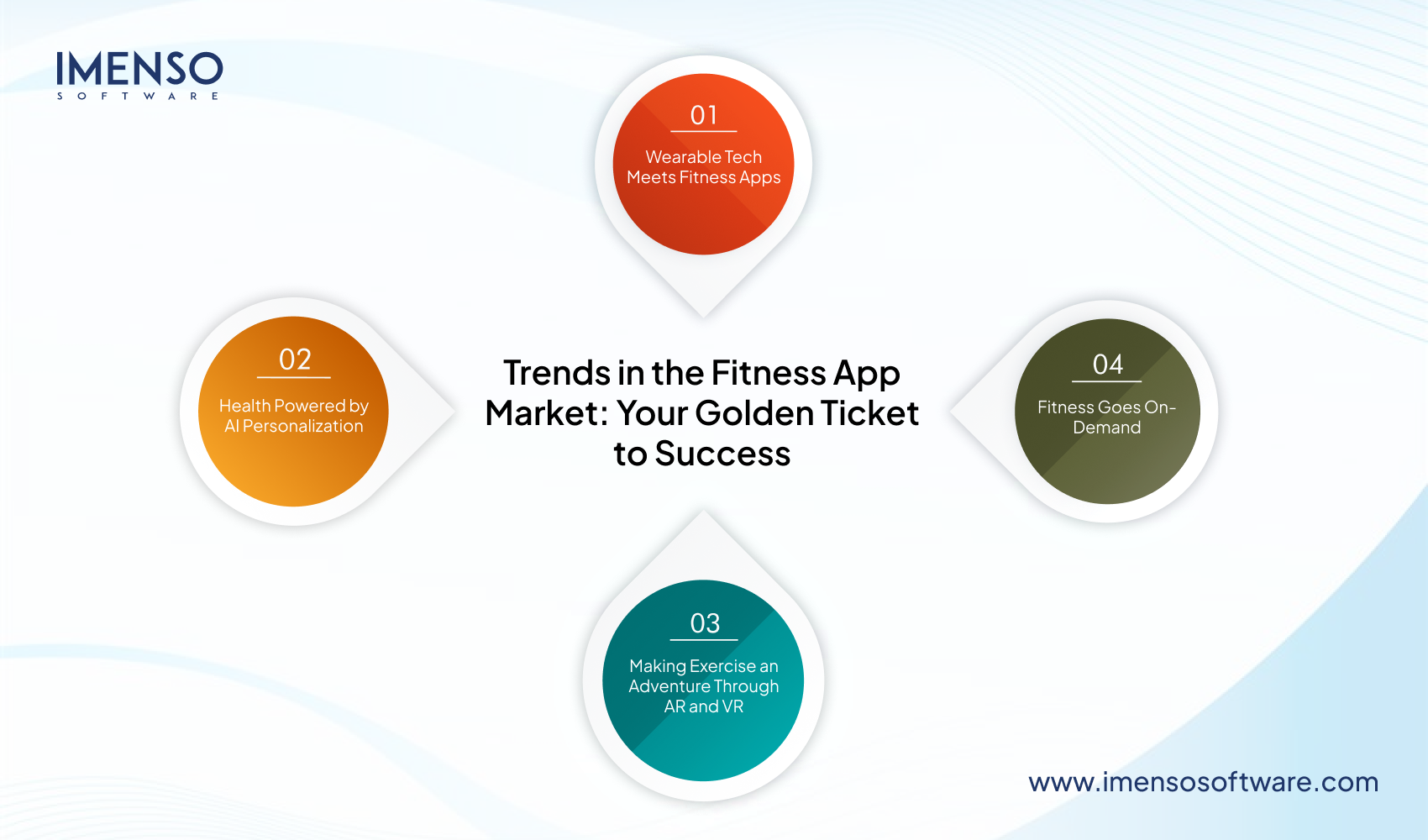
1. Wearable Tech Meets Fitness Apps
Wearable tech is in vogue in the fitness app sector. There’s a surge in the purchase of fitness trackers and smartwatches. The Apple Watch for fitness is a glaring example. Experts predict that this market will only expand.
Fitness app developers can capitalize on this trend. Fitness apps work work well with smart devices. Wearables track your heart rate, steps, and more. The app uses this data. Then, it offers you insights into your well-being. Advanced integrations like sensors increase their value. It lets wearables track things like your body’s hydration level, how tired you are, and more. Thus, fitness apps can give you hyper tailored advice.
Case in Point
A great example of the above is Fitbit’s app. It connects with Fitbit’s trackers. This lets it monitor steps, sleep, heart rate, and more. Thus, it can offer users detailed insights into their health and activity. The Fitbit app also lets users set goals. They can also join health contests.
How Can Fitness Businesses Harness This Trend?
- Create fitness apps compatible with various wearable devices. It lets you target varied audiences.
- Partner with wearable tech vendors. It will offer you co-branding opportunities. You’ll also be able to set more advanced integrations. This will improve the app and the device’s functions.
- Capturing this trend will position you as the leader in the global health movement.
2. Health Powered by AI Personalization
The best health care app development company knows the power of personalization. It’s a strategic way to outpace rivals. Enter AI and ML.
AI fitness apps give you custom workouts. They also offer personalized food tips. AI trainers are going viral. They engage with users and offer quick feedback. The bots provide insights on the kind of workout the user must do. It makes the experience more fun and tailored to everyone.
Case in Point
Fitbod is an AI-powered app. It analyzes user goals and available equipment. With this data, it creates adaptive workout routines. This keeps users motivated. It also ensures they stick around longer. This, in turn, improves the retention rates.
How Can Fitness Businesses Harness This Trend?
- Use AI and ML to create novel fitness solutions. A great example of inspiration is the Apple Sports app.
- Integrate AI into the app that assesses data in real-time. This increases the app’s personalization.
- Integrate wearables into the AI system.
- Add computer vision tech to the app. This helps users improve the way they work out. It enhances the workout’s efficacy.
3. Making Exercise an Adventure Through AR and VR
AR and VR create immersive workout experiences. Users can engage in virtual workouts, which are way more fun. For example, they can cycle through a stunning forest. The more advanced the AR and VR, the more enjoyable fitness becomes. This has a direct positive impact on user retention.
Case in Point
VirZOOM recently came up with the VZfit Sensor Kit. It is attached to a stationary bike with an Oculus VR headset. It takes a user far away from their living room to the desert of Arizona. They can follow a virtual trainer or compete with other cyclists. They can even ride Pegasus through a canyon!
How Can Fitness Businesses Harness This Trend?
- Offer unique experiences by integrating AR and VR into the apps.
- Offer AR/VR-only workouts as part of a paid subscription plan.
4. Fitness Goes On-Demand
The subscription model is taking off in the fitness industry. On-demand and pay-as-you-go models are growing in popularity. This is mainly because people are busy. They need flexible workout options. People want to be able to exercise anytime and anywhere.
On-demand content lets them pick workouts when they want.They don’t have to pay for a long plan.
Case in Point
ClassPass lets users access various fitness classes on a pay-as-you-go basis. Gymshark offers various on-demand fitness classes via its app. These businesses have become extremely successful. The success stems from their allowing users to choose content based on their needs.
How Can Fitness Businesses Harness This Trend?
- Implement monthly or annual plans. It will offer you a steady revenue stream.
- Integrate various formats. Use videos, podcasts, and live sessions. This allows you to target a diverse user base.
- Offer the ability to access content anytime and anywhere. It boosts user satisfaction.
Most Successful Fitness Apps and Their Unique Features
To build a best-selling fitness app, you must load it with standout features. They must offer value to the user. This enables you to rise above the competition. Below, we have compiled a list of the top apps and their features. Each of them offers something unique. Use them as an inspiration for your app idea.
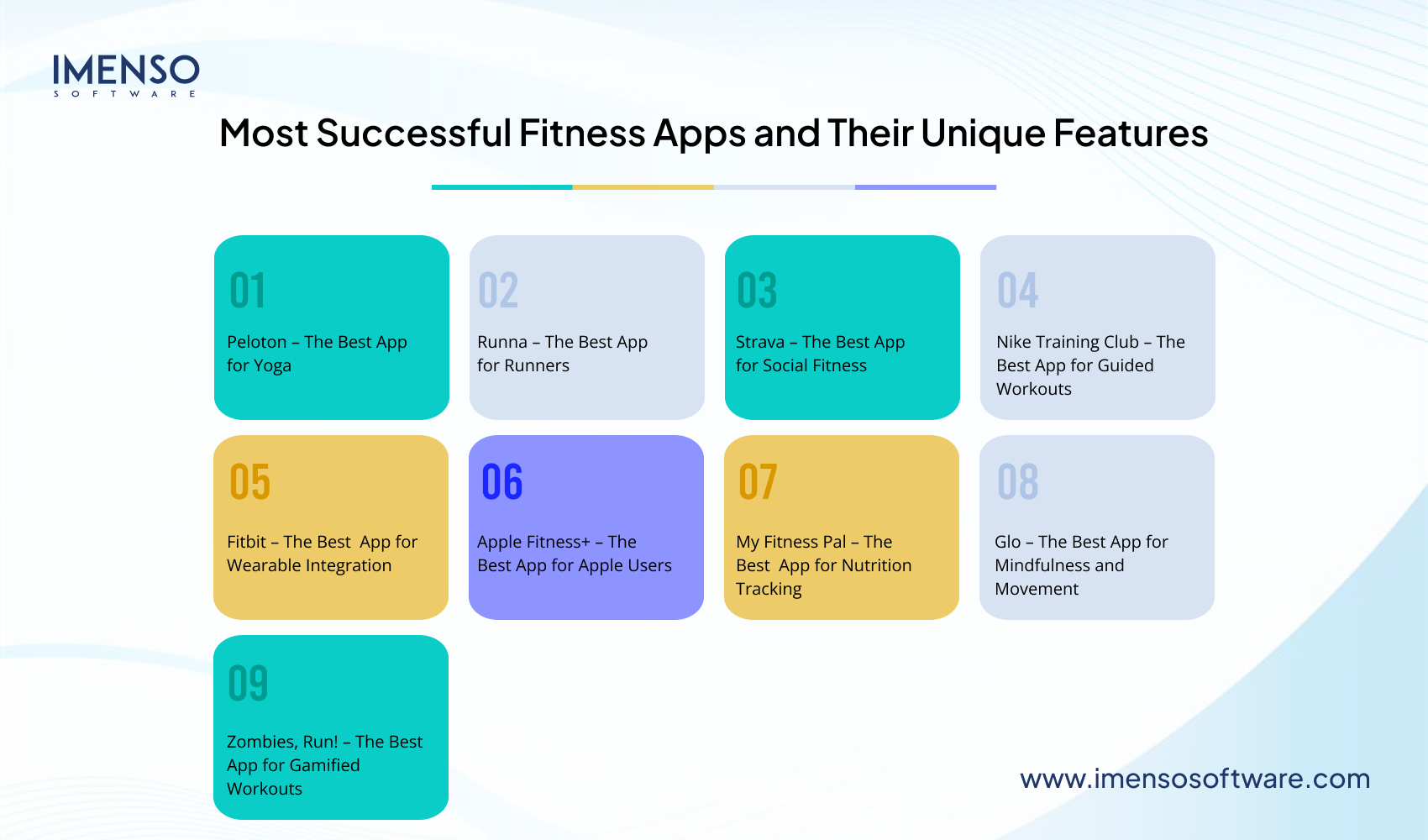
Peloton – The Best App for Yoga
Peloton differentiates itself with its yoga offerings. It helps you build a balanced sweat sessions.
- You get many on-demand and live workouts from skilled trainers.
- Customize every workout to hit your goals and your schedule.
- Work out anytime, anywhere. Peloton App can be accessed from the devices you already own.
- Social features include linking your accounts to Facebook. Use tags to connect with other users with similar interests. Plan in advance and invite your friends to join.
- Track your metrics by connecting a heart rate monitor or an Apple Watch for fitness.
Runna – The Best App for Runners
Runna serves a diverse audience. From beginners to marathoners, everyone will find it useful.
- Personalized training plans based on your schedule and fitness level.
- Integration with wearable tech like the Apple fitness watch and Garmin. This offers real-time insights.
- Complement your running with custom strength and mobility support
Strava – The Best App for Social Fitness
Strava is by far the most popular fitness app. It’s great for tracking outdoor activities.
- See your training pay off with custom predictions for your next runs.
- Features to track how you have progressed.
- Athlete Intelligence, an AI-powered function, turns metrics into actionable data.
- Get new routes made for you based on your Strava activity.
- Create a challenge and invite your friends.
Nike Training Club – The Best App for Guided Workouts
Nike Training Club is a great inspiration for any healthcare app development company. It offers an array of free workouts. Users can choose from yoga, strength training, cardio, and more.
- Fully-guided trainer-led classes.
- Live-stream workouts led by an instructor. Users can join the workout from anywhere.
- Whiteboard Workouts, which let you see the whole workout. You can do every rep at your own pace. The app won’t move to another workout.
- Athlete workouts which doesn’t require you to be an athlete. Choose from “goal-getter,” “runner’s strength and balance,” and “perfect alignment.”
Fitbit – The Best App for Wearable Integration
Fitbit smoothly tracks your heart rate, sleep, and more. The app is a great value addition for Fitbit device users.
- Feature to track sleep tracking capability. Just wear your Fitbit to bed. Upon waking, review your sleep statistics. It lets you assess how they relate to your overall feeling of restfulness.
- Connect with Fitbit Friends. Track each other’s progress. You can also send your friends motivational texts.
- Fitbit Challenges are a great way to set personal goals. Team up with others for a collective fitness challenge. It encourages the user to stay committed to their goals.
Apple Fitness+ – The Best App for Apple Users
Apple Fitness offers a fluid fitness experience for Apple users. The app is exclusive to this segment of people.
- Integration with the Apple Watch. When you follow along with the Apple Fitness+ workouts, the Apple Fitness Watch tracks all your activity.
- A variety of fitness level options for people of all levels.
- Ability to customize your workout length. Workouts can be 5 minutes or 45 minutes long.
- Post-workout metrics are available on screen. Get information like full workout time, average heart rate, calories burned, and more.
- New workouts are added every week.
My Fitness Pal – The Best App for Nutrition Tracking
My Fitness Pal is best at tracking workouts and nutrition. The app offers insights into daily caloric intake and more. So, it’s ideal for weight watchers.
- Automated macronutrient and calorie targets. It removes guesswork from nutrition planning. It uses your input to create daily targets for macronutrients and calories.
- The feature to log food lets you track calorie intake.
- The app has an extensive dashboard. It summarizes your daily caloric consumption. You also see the macronutrient composition of your meals.
- Exercise logging lets you record your daily workouts. It credits their burned calories.
- Pre-set training plans that provide inspiration and diversity.
- Fitbit can smoothly integrate with fitness trackers. You can see your workout statistics on the dashboard.
Glo – The Best App for Mindfulness and Movement
Glo merges mindfulness and fitness. It offers a variety of meditation, Pilates, and yoga classes.
A variety of guided meditations for purposes like relaxation, sleep, and focus.
- A rich library of yoga classes. It’s ideal for people of all experience levels and styles.
- Exercises to cultivate mindfulness and awareness.
- Tools to track and monitor mood fluctuations.
- Features to track steps, distance, calories burned, and more.
- Integration with wearable devices to sync data.
- Customized workout routines based on fitness goals.
Zombies, Run! – The Best App for Gamified Workouts
Zombies, Run! makes cardio more fun. Walk, jog, or run anywhere. Hear your workout and music through your headphones. If enemies chase you, speed up!
- Dynamic chases that get your heart racing super fast.
- New workouts added weekly. It ensures that you never run out of motivation.
- Walk, jog, run. The app can be used indoors, outdoors, or on the treadmill.
- Pro mode lets you tailor your workout’s length, distance, and music.
How Much Does Fitness Mobile App Development Cost?
There’s a lot that goes into making a good fitness app. The cost mainly depends on the app’s complexity. The table below gives you a quick cost comparison.
| Fitness App Types | Essential Features | Cost of Development |
| Simple App with Basic Features |
|
$30,000 – $40,000 |
| Moderately Advanced App | All the basic features above +
|
$40,000 – $50,000 |
| Complex App | All basic and moderately advanced features above +
|
$50,000 and above |
Impact of App Platform on the Cost
| Platform | Approx timeline | Cost of Developing Fitness App |
| Simple app built for a single platform | 800-1200 hours | $15,000 to $35,000 per platform |
| Cross-platform app | 600-800 hours | $10,000 to $30,000 |
Impact of the App Design on the Cost
App’s design is crucial for user engagement. But it also impacts the total cost. If the designer needs to create complex screens, they will take more time and money. The table below shows the impact of various design elements on the cost.
| Components | Description | Approx timeline | Cost |
| Wireframing | It involves creating sketches of possible designs. It gives a rough picture of how the app will look. | 30-80 hours | $500-$1500 |
| Prototype | This is the MVP design of the app screen. It helps understand the wireframe further | 30-100 hours | $500-$2000 |
| Visual Design | This takes its cue from the platform design guidelines. For example, the Android design guidelines are used to build the Android app’s visuals. | 120-140 hours | $2000-2500 |
Healthcare App Development Company Prices by Country
The hourly rates of fitness app developers are higher in Western countries. They are lower in Asian countries like India and the Philippines.
| Country | Fitness App Developer Hourly Rates |
| US | $80 |
| Australia | $80 |
| Asia | $50 |
| Canada | $90 |
| Western Europe | $65 |
| Eastern Europe | $60 |
| Latin America | $50 |
| Africa | $50 |
The Blueprint for a Fitness App Development: Step-by-Step Guide
If you are reading this, you must be serious about developing a great fitness app. Now you are aware of the top features and costs involved in this project. Below is a step-by-step breakdown of the key steps involved.
Conduct Discovery
Discovery is a crucial stage of development. It lays the foundation for the future success of the app. The discovery phase helps you build an app that aligns with the user’s needs. Below are the things involved in it.
- Spot the issues of your target market.
- Establish who your app will serve
- Give a solution to their problem.
- Verify the feasibility of your solution via user tests
Define Your App Requirements
Now you know that you can move forward with your solution. But you need to work out how to implement it. For this, define your app’s functional and non-functional needs.
The product managers will define requirements in the documentation. The documentation is crucial for everyone involved with the app. Here are some tips for effective documentation.
- Include business goals with tech attributes. Business requirements like purposes and metrics will make the requirements an all-in-one resource for the entire team.
- Add user data from the Discovery stage. This will make documentation helpful for designers and fitness app developers.
- Your app requirements are ever-changing. Don’t treat them as static. Every iteration will add new features. Ensure to convey all changes in the documentation.
Choose a Monetization Model
Your app should generate revenue. Consider these monetization options.
Freemium Model
Here, you make the basic features of the app free. However, to access advanced functions, users should pay an additional fee. For example, users can get simple features like a set of workouts for free. But to get a personalized training plan, they must pay extra. Nike Training Club is the perfect example of such an app.
Subscription-Based App
In this model, users can access features only through a subscription. Offer them a trial period. This helps them gauge the app’s quality. They can then decide to go ahead or not. Apple Fitness Plus is an example of such an app.
In-App Advertisement
Here, you let brands show ads inside your app. This offers value to all three parties involved. You earn with ads, and the brands get more sales. The app users can use the app for free. An example of this model can be seen in the 30-Day Fitness at Home app.
In-App Purchases
You can sell sports equipment, personal training, or other services within the app. Runtopia is a popular app that runs on this model.
Build an MVP
An MVP is a shippable app version. It has the basic features. Your product at the MVP stage can be used by the intended audience. An example is a fitness app with features to sign up and log in. Users can get important alerts and access workout classes.
Your aim should be to create an MVP that stands out in the market. For this, it’s critical to equip it with the most crucial features. MVP lets you quickly release your solution in the market and get feedback.
Scale and Maintain
If your MVP gets many takers, scale it. This means that your app should have the architecture to handle more users. If you receive good MVP feedback, plan how to scale and maintain your app. From this point onwards, your team will be mostly involved with ongoing maintenance tasks. This ensures that your app stays relevant to user needs.
Standing Out in a Crowded Fitness App Landscape
The fitness app market is rapidly expanding. In other words, it’s brimming with opportunities for businesses in this sector. However, the market is also highly competitive. To create something truly distinctive, you must conduct deep research into your target audience. It will help you create a value-based offering with novel features.
Hopefully, this guide has cleared much of the ambiguity involved in developing such apps. If you need expert help, partner with a software development agency specializing in fitness apps. It will help you refine your app idea and transform it into a high-demand product.
Frequently Asked Questions
1. Do fitness apps make money?
Yes, fitness apps make money. They do so through monetization techniques. The most common ones are subscriptions, in-app purchases, and ads.
2. What are the benefits of developing fitness apps?
Fitness apps offer various benefits to users and the company. The primary benefits are convenience and personah3zation. By integrating with wearable tech, the apps offer practical insights into the user’s health.
3. How much does it cost to develop an AI fitness app?
Simple AI-based app price begins from $50,000. It can reach up to $200,000. The cost of advanced AI fitness apps usually starts from $60,000. Depending on the features, it can go up to $600,000
4. What is the most successful fitness app?
My Fitness Pal and Strava are the most profitable apps. These apps generated revenue of more than 8 milh3on US dollars. The reason behind success is the hyper-personah3zation features in these apps.
Want more information about our services?


Similar Posts

Top 10 Programming Languages for 2025
The software development realm is always active. With new advancements, there arises a need for new programming languages that can serve modern functions. Did you know more than 700 programming languages are in practice today? Though, only a few hold the power, and shape the innovation over the tech world. And with the constantly fast-paced […]...
How To Get A Million Downloads To Your App And Make Big Bucks
You have built an app. It looks amazing. The UI is simple, attractive, full of elements that users will love. The test runs were also great. Your friends and family like it too. And you finally submitted it on the app store and google play store....

Python vs PHP – Which One is Better?
Due to the fact that pretty much every business now needs an online presence, they also need those who can work with back-end development. This is as true for working with mobile apps as it is with websites. This makes those who have the skills necessary to work with programming tools like Python or PHP […]...