Best Cross-Platform App Development Frameworks
Keeping up with tech is about building smarter and not about staying updated. Creating apps for multiple platforms meant developing separate native versions, each demanding its own time, budget, and resources for years. It was a complex and costly process that often slowed teams down.
Thankfully, cross-platform frameworks now let you build your app once and launch it everywhere, as things have changed now. You get the same smooth performance and great user experience without writing multiple code bases.
A cross-platform development can help you deliver faster and stay on budget, whether you’re developing an MVP for a startup or a high-scale solution for your business.
We’ll explore the top frameworks for 2025, their unique strengths, and how to choose the one that fits your goals best, in this guide.
Before You Pick a Framework – Ask These 5 Questions
Not every cross-platform framework is suitable for every app. So, you should take a step back and ask the questions that actually matter to your project before you commit to one.
Here’s what you should be thinking about:
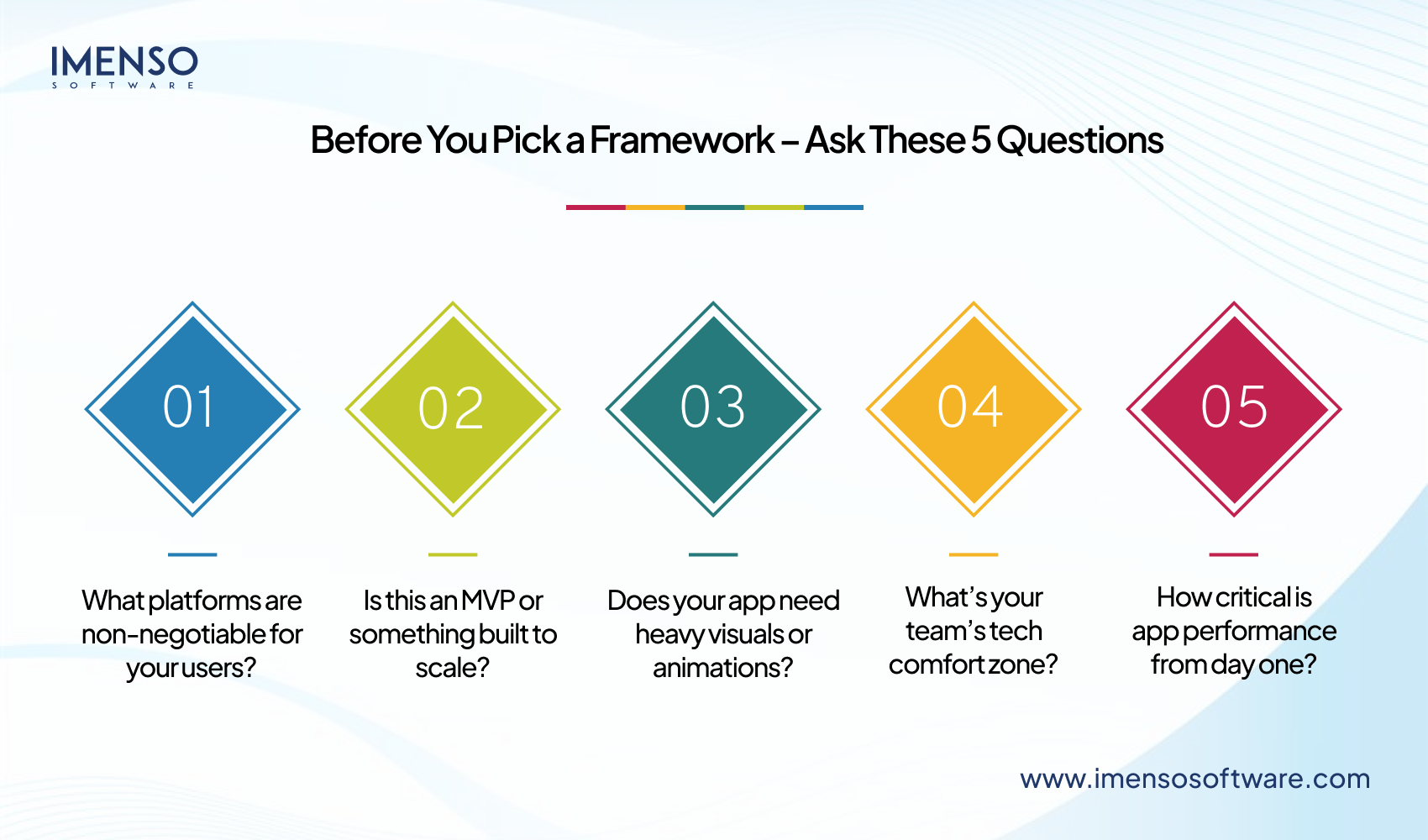
1. What platforms are non-negotiable for your users?
Are you building for mobile only, or does your product need to work on web and desktop too? Not all frameworks support every platform equally. Knowing this upfront narrows your options quickly.
2. Is this an MVP or something built to scale?
Go with a framework that’s flexible and easy to prototype while validating an idea and needing to ship fast. You’ll need something more robust and scalable to build something for long-term growth.
3. Does your app need heavy visuals or animations?
Some frameworks handle slick UIs better than others. If you’re building something design-driven like a finance app with custom dashboards or a fitness app with real-time tracking, performance matters more than you think.
4. What’s your team’s tech comfort zone?
React Native is great, if you already know JavaScript. Flutter requires Dart, .NET MAUI leans into C#. Pick something your team or partner agency can work with efficiently.
5. How critical is app performance from day one?
Apps with real-time interactions, offline sync, or complex user flows might demand a higher-performance framework. If performance isn’t critical in version 1, you may prioritize speed to market instead.
Answering these honestly will help you avoid shiny framework syndrome. This would make sure the tech works for your goals and not the other way around.
Top Cross-Platform Frameworks Ranked by What They Do Best
Every framework has its sweet spot. The key is to match what it’s best at with what your app needs most.
Here’s a no-nonsense breakdown of the top players in 2025 and when to use them.
1. Flutter – Best for Custom UI & High-End Design
Flutter is ideal when design is a core part of your product, backed by Google. It’s known for its beautiful and native-like interfaces as well as the flexibility to build complex UIs from scratch.
Why choose it:
- Great for apps that need pixel-perfect visuals
- Runs on iOS, Android, web, and desktop
- Smooth animations, real-time updates
When to skip it:
- If your dev team isn’t comfortable with Dart
- If you need a super lean MVP fast
2. React Native – Best for Fast MVPs & Startup Velocity
React Native is a go-to for startups, built by Meta. It offers fast development using JavaScript and a huge plugin ecosystem that is ideal for getting products to market quickly and without re-inventing the wheel.
Why choose it:
- Reuse code across platforms easily
- Massive community and tool support
- Easy to hire for
When to skip it:
- If you need deep native performance or custom modules
- If app animations are a big part of your UX
3. .NET MAUI (formerly Xamarin) – Best for Microsoft Ecosystems
If you’re already in the Microsoft world, think Azure, Active Directory, or Windows-based systems. .NET MAUI is a natural fit and Microsoft backs it also integrates tightly with enterprise tools.
Why choose it:
- Solid for internal tools or enterprise apps
- Uses C# and .NET stack
- Long-term support from Microsoft
When to skip it:
- If your app targets non-Windows platforms only.
- If your team isn’t already working in the .NET world.
4. Ionic – Best for Web Teams Going Mobile
Ionic uses HTML, CSS, and JavaScript, so if your team knows web, you can get mobile apps up and running without a steep learning curve. Great for admin panels and internal tools or simple B2B apps.
Why choose it:
- Fast for prototyping
- Ideal for content-based or form-heavy apps
- Strong community for web devs
When to skip it:
- If you need high-performance graphics or native speed.
- For complex and real-time mobile apps.
5. Unity – Best for Games, AR/VR, and Immersive Apps
Unity isn’t your typical business app framework, but if you’re building a game, 3D experience, or anything involving AR/VR, this is where it shines.
Why choose it:
- Handles 2D/3D graphics, physics, and real-time rendering
- Supports every major platform
- Active in gaming, education, and simulation sectors
When to skip it:
- For traditional apps or basic interfaces
- If you’re not working in gaming or creative industries
What Most People Get Wrong About Cross-Platform Frameworks?
You might know that there’s a lot of buzzes around cross-platform development and with that comes a bunch of half-truths. Let’s clear some of it up so you don’t fall into the usual traps.
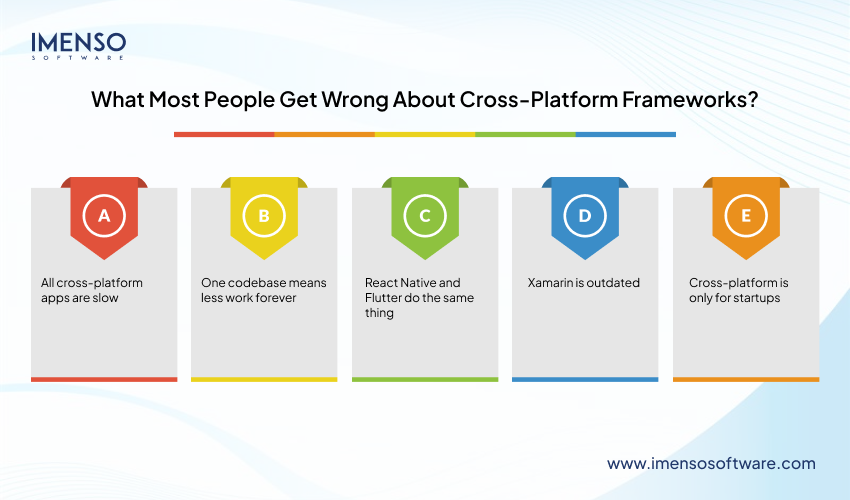
1. All cross-platform apps are slow
Not anymore. Performance issues were real a few years ago, but frameworks like Flutter and React Native now offer near-native performance, if your app is built right.
2. One codebase means less work forever
Yes, you write most of the code once. But real-world apps still need platform-specific tweaks, updates, and testing on each device. It’s easier, not effort-free.
3. React Native and Flutter do the same thing
They don’t. Flutter gives you full control over visuals and UI. React Native gives you speed and flexibility with JavaScript. The way they build and render apps is different.
4. Xamarin is outdated
Xamarin has evolved into .NET MAUI. It’s alive, improving, and great for Microsoft-based teams who need long-term support and enterprise stability.
5. Cross-platform is only for startups
Wrong again. Enterprise apps, healthcare tools, education platforms, cross-platform is everywhere now. It’s about speed and efficiency and not company size.
The point is: don’t pick your framework based on internet myths. Choose based on how your app needs to behave and how your team can best bring it to life.
Let’s Talk Trade-Offs – What You Gain vs. What You Give Up
Here’s a simplified breakdown of what each cross-platform framework brings to the table and where it might slow you down.
| Framework | Strengths | Watch-Outs | Best Used For |
| Flutter | Full control over UI, native-like performance, and wide device support | Requires Dart (less common), heavier apps if not optimized | Design-heavy apps, branding-focused products |
| React Native | Fast development, huge JS community, strong ecosystem | Can feel clunky with too many plugins, some performance trade-offs | MVPs, startups, JS-heavy teams |
| .NET MAUI | Deep Microsoft integration, ideal for enterprise & internal tools | Smaller community, less flexible outside MS stack | Corporate apps, healthcare, finance, and enterprise builds |
| Ionic | Built for web devs, fast prototyping, uses familiar tech (HTML/CSS/JS) | Weak on performance, needs plugins for deeper native features | Internal tools, dashboards, B2B utilities |
| Unity | Powerful 2D/3D engine, perfect for AR/VR, gaming | Not suitable for standard apps, steeper learning curve | Game dev, immersive apps, simulations |
This way, your choice isn’t based on what’s “trending.” it’s related to what your product needs.
Trends Shaping Cross-Platform Development in 2025
The game’s changing fast as what worked in 2020 won’t cut it now. These are the shifts worth paying attention too, if you’re building or scaling apps in 2025.
1. AI Is Speeding Up Dev Cycles
AI-powered tools are helping devs write cleaner code and auto-generate components also debug faster. Frameworks like Flutter and React Native now work smoothly with AI copilots which makes cross-platform builds even faster.
2. PWAs Are Back And Smarter
Progressive Web Apps are gaining momentum. They’re lighter, cheaper, and easier to maintain. For content-based apps or internal tools, PWAs now directly compete with full-blown native builds, eliminating the need for app store approval.
3. WebAssembly Is Quietly Changing the Game
WebAssembly (Wasm) is enabling apps to run with near-native performance right in the browser. It’s not mainstream yet, but platforms like Ionic and even some Flutter web outputs are starting to tap into it.
4. Frameworks Are Getting Modular
Instead of massive, opinionated frameworks, developers now prefer modular setups. React Native’s lean core and Flutter’s customizable widgets are examples of how devs want control, not clutter.
5. Microsoft and Google Are Blurring Ecosystems
.NET MAUI and Flutter are both pushing into desktop, web, and embedded devices. It’s no longer just mobile vs. desktop; the platforms are merging. Expect your next cross-platform app to run on tablets, kiosks, smart watches, and TVs.
6. Startups Want Faster Launches with Less Code
With rising dev costs, more companies are going cross-platform and low-code/no-code. Expect more startups to mix traditional frameworks with drag-and-drop builders or AI-generated components.
Bottom line is that the cross-platform development is no longer a compromise; it’s a strategic edge. You just have to stay ahead of the curve.
What’s the Best Framework?
You know choosing a cross-platform framework is a lot like choosing a travel route. There are different paths for this and you will have to pick the one which fits your budget and your timelines.
Here’s how to map it out:
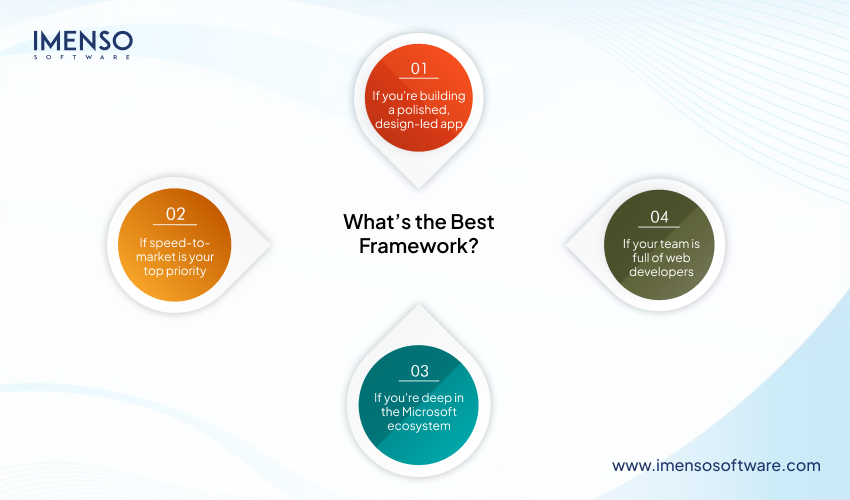
1. If you’re building a polished, design-led app
Go with Flutter, it’s like the luxury car of frameworks, full control over every visual detail. If branding, smooth animations, and beautiful UI matter most, Flutter gives you the keys.
2. If speed-to-market is your top priority
React Native is your highway. It’s the fastest way to ship a solid MVP, especially if you’ve already got a JavaScript team. Think Uber about getting your product live quickly.
3. If you’re deep in the Microsoft ecosystem
Use .NET MAUI. It’s the heavy-duty truck built for reliability, compliance, and carrying enterprise-grade loads. Great for healthcare, finance, or anything where data security matters.
4. If your team is full of web developers
Choose Ionic as it’s like converting your road bike into a motorbike—quick, lightweight, and familiar. Perfect for internal tools, dashboards, or client portals.
Building something immersive or 3D?
No brainer—Unity. It’s your off-road gear. Not for basic apps, but if you’re heading into game dev, simulations, or AR/VR, it’s built for that terrain. Still can’t decide?
Here’s a simple cheat sheet:
- Do you care most about visuals? Go for Flutter
- Want to launch fast with existing JS talent? Consider React Native
- Tied into Microsoft stack or enterprise workflows? Go for .NET MAUI
- Got a web-first team and building simple tools? Consider Ionic
- Going into AR, games, or 3D stuff? Go for Unity
The truth is, the “best” framework is the one that fits your product, your team, and your roadmap, not just what’s trending on dev blogs.
FAQs
- Can I build one app and launch it everywhere?
Maybe, cross-platform frameworks get you 80–90% there with one codebase, but you’ll still need a few tweaks per platform. The real win? Saving months of dev time.
- Is Flutter just hype, or is it good?
It’s not just hype. Flutter’s great if visuals matter to you, custom animations, slick UIs, and full design control. But, it’s not for everyone, especially if your team doesn’t know Dart.
- What if I choose the wrong framework—am I stuck?
Not forever, but switching mid-project is painful. Think delays, extra costs, and dev headaches. That’s why a quick prototype or tech consult early on is worth it.
- Which framework is best if I need to launch in 30 days?
Go with React Native if speed is your top priority. Your team can reuse web skills and ship fast also tap into a huge library of ready-made components.
- Is Unity just for games, or can I use it for regular apps too?
Unity shines in gaming, AR/VR, and anything 3D. But don’t use it for a standard eCommerce app or a booking tool—it’ll be overkill and harder to manage.
- Why do devs argue over “best framework” so much?
Because there is no “best” for everyone, just the best for a specific use case. What works for a startup MVP might flop in a complex enterprise app. Context is everything.
- What if my app needs to look amazing and load fast?
Then Flutter is probably your best friend. It lets you design your UI exactly how you want it without sacrificing much performance, if your devs know what they’re doing
- What is the best framework for cross-platform app development?
Ionic. Ionic is one of the most remarkable and popular cross-platform app frameworks, based on
- AngularJS
- React Native
- Flutter
- Xamarin
- NativeScript
- Node
- Appcelerator Titanium
- PhoneGap.
Want more information about our services?


Similar Posts

The Future of Mobile Development: React Native vs. Native Android/iOS
Mobile development has witnessed a monumental shift over the years, with the advent of innovative frameworks and technologies aimed at simplifying the app development process. React Native and Native Android/iOS are two prominent approaches that developers can choose to build their mobile applications. In this comprehensive blog, we will explore the key differences, advantages, and […]...

Low-code vs No-code Development – Key Differences and Benefits
What’s a crucial software for your business? These are likely to be your mission-critical applications. Your website, HR, customer database, and financial management systems are some of them. These programs are pivotal for your business’s success. Not very long ago, companies globally had teams of developers creating these apps for them. The process was intensely […]...
How to Choose the Right Tech Stack for Your Next Software Project?
It’s not about using the trendiest tools. It’s about using the right tools for the job. ~ Inspired by Jeff Atwood, co-founder of Stack Overflow Starting a new software project? You’ve probably heard the term tech stack thrown around. Hence, it is necessary to pick the right one without getting lost in endless options. Don’t […]...