How Much Does it Cost to Maintain Software? – A Detailed Guide
Fastly is a cloud computing provider trusted by big companies globally. On June 8, 2021, it faced a network outage that disrupted the internet for the entire world. Sites like Amazon and the BBC, among others, suddenly vanished from the face of the Earth.
These websites rely on Fastly to distribute their content swiftly to their users. Now, they were left clueless.
The cause behind the debacle?
Just a routine configuration change by a Fastly customer. It triggered a bug within the system. This, in turn, led to a bunch of Fastly returning errors. It massively disrupted online services.
When One Glitch Shakes the Web: The High Stakes of Software Failures
The example above highlights the risks of not addressing potential software weaknesses. Fastly’s expenses went beyond technical fixes. It also faced revenue loss and reputational damage.
This incident serves as a crucial reminder for owners of digital apps. It is the importance of continuous software maintenance.
Yes, software maintenance cost is an additional expense after development. But it’s critical to deliver the best user experience.
In the past years, money spent on low-quality software in the US increased to over $2 trillion. Technical debt alone ballooned to more than $1 trillion!
– Consortium for Information & Software Quality
What Are Software Maintenance Costs?
Software maintenance involves upgrading the solution. This is done by fixing any current issues. Developers also enhance the software with more features. The aim is to improve the overall performance of the system.
The maintenance cost of software comes after it’s ready to use. It means that the solution is present in the market. So, the maintenance costs are expenses that occur to upgrade the software.
Besides fixing technical glitches, it also involves updating security requirements. The company also incurs expenses for updating compliance requirements. Things like upgrading the software’s hardware add to the total cost.
Each of these processes is critical to ensure the workability of the system. Knowing software maintenance costs helps you plan and execute appropriate processes smoothly.
Types of Software Maintenance
Every company should know about the four types of maintenance. You need all of them at various stages.
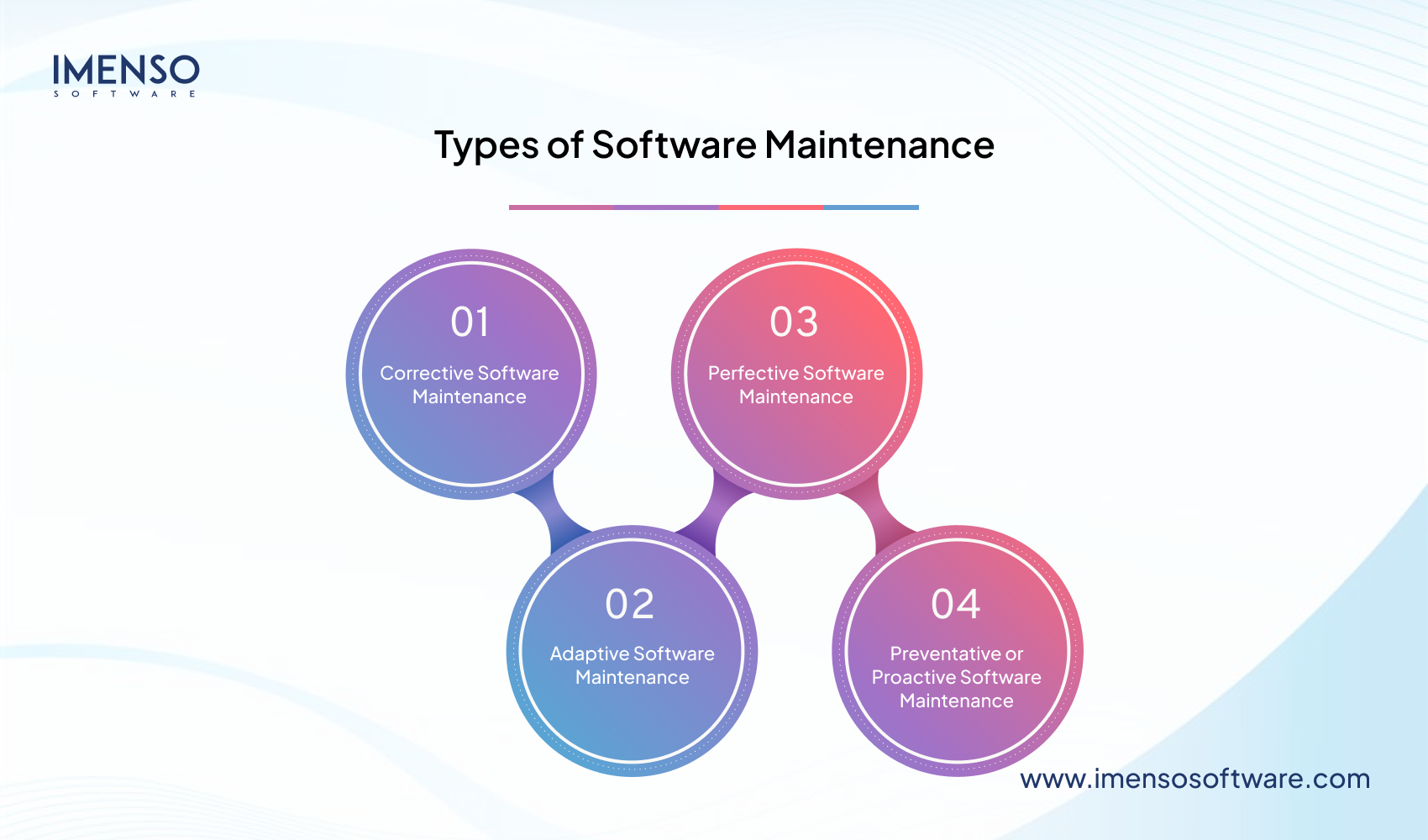
1. Corrective Software Maintenance
It addresses the issues that impact various aspects of your product. These are logic, code, and design. Corrective maintenance allows you to find bugs early. This lets you give a great user experience. It covers around 20% of the total software costing. This percentage can increase or decrease. It depends on whether the software is new or in development.
- Suited for low-priority development
- Can cause runaway repair expenses
2. Adaptive Software Maintenance
It encompasses updates to the OS. This type of maintenance also includes updates to cloud storage and hardware, and software dependencies. Products in a swiftly changing environment need this maintenance. It takes up about 15% of the maintenance effort. Again, the percentage can go up or down. It depends on the changes in your software environment. You are likely to incur more if there are frequent changes to regulatory policies.
- Extend the lifespan of software
- Requires much time, skill, and resources
3. Perfective Software Maintenance
Perfective maintenance involves enhancing the product features. Teams may also remove features if they aren’t needed. The sole aim is to improve the product’s quality. It covers around 25% of the cost of software maintenance. The percentage can also change. It relies on the kind of focus the team has on improving the software’s usability.
- Timely and informed monitoring
- Can be costly to set up
4. Preventative or Proactive Software Maintenance
Spotting and fixing issues before they occur is the aim of this maintenance. It serves as a proactive approach to plan and implement changes for potential glitches. Commonly, it identifies and fixes invisible bugs in the code. Preventive maintenance covers around 10% of the overall maintenance effort.
- Best to execute without expertise
- PM creep can occur without optimization
POINT TO NOTE
It’s common to use preventative and corrective maintenance synonymously. But doing so is wrong. Preventative maintenance spots and resolves issues before they become blunders. Corrective maintenance manages errors after they have occurred. Preventive maintenance is thus key for effective software.
- Smaller companies spend an average of $121,336 yearly on software.
- Mid-sized firm spend around $193,716.
- Larger SMBs invest about $251,119 in software annually.
How much does software maintenance take up this massive investment?
Estimating Software Project Cost Based On Different Types Of Maintenance
| Type of Maintenance | Description | Estimated Monthly Cost | Key Cost Drivers |
| Corrective Maintenance | Fixes glitches and defects in design, logic, or code. | $2,000 – $12,000 | Bug seriousness, complexity, testing needs, downtime impact |
| Preventive Maintenance | Increases future reliability, code improvement, and documentation changes. | $600 – $9,000 | Software complexity, legacy code refactoring, and documentation coverage |
| Perfective Maintenance | Adds new features based on user feedback or new trends. | $4,000 – $25,000+ | Type of new features, UX/UI upgrades, and additional integrations |
| Adaptive Maintenance | Ensures compatibility with new OS, hardware, and external services. | $2,000 – $18,000 | API integrations, OS updates, regulatory changes, and device compatibility |
| Security & Compliance | Security patching, compliance updates, and audits. | $2,000 – $12,000 | Industry-specific compliance (e.g., GDPR, HIPAA), and update rate |
| Performance Optimization | Improves speed, scalability, and reliability. | $1,000 – $8,000 | Software usage, analytics, and external tool performance |
| Interface Updates | Enhances design, navigation, and responsiveness,. | $2,000 – $10,000 | Platform scope (web, mobile), design patterns, accessibility rules |
| Technical Debt Cleanup | Refactoring bad code, and updating obsolete libraries. | $4,000 – $15,000 | Tech stack newness, developer’s experience, quality of documentation |
| Infrastructure Upgrades | Server, hosting, and database, cloud optimization. | $600 – $8,000 | Server load, data storage demands, backup frequency |
| Third-party Expenses | Licensing, plugin updates, changes in API, and SaaS fees. | $500 – $3,000 | Dependency quantity, vendor costs |
| Developer Accounts | App Store, Play Store, and GitHub, CI/CD tools. | $30 – $1,000 | Number of systems used, and team collaboration tools |
| User Feedback Integration | Gathering, analyzing, and executing user-driven enhancements. | $500 – $8,000 | Feedback channel setup, the volume of feedback, manual or AI-powered processing |
| Documentation Updates | Keeping code and user guides updated. | $300 – $4,000 | Team structure, update size, and documentation tools |
How to Calculate the Maintenance Cost of Software?
Almost every company wonders: How much does software maintenance cost? You cannot guess the answer. It depends on various factors. Software maintenance is complex. Some tasks might need you to fully overhaul the product. Here, the cost can range between $5,000 – $50,000 per month.
The kind of maintenance you need and the app users affect the cost. Your software type also impacts the total expenses. More critical is the fact that maintenance is a continuous process. So, you’ll need to keep a dedicated budget at all times.
How To Estimate Software Development Cost: The COCOMO Approach
To estimate the cost accurately, experts have devised many methods. The COCOMO (Constructive Cost Model) has proven to be an effective one. Barry W. Boehm created it in 1981. We use this model as the basis of our cost estimation. A recent study has proposed the estimation method below.
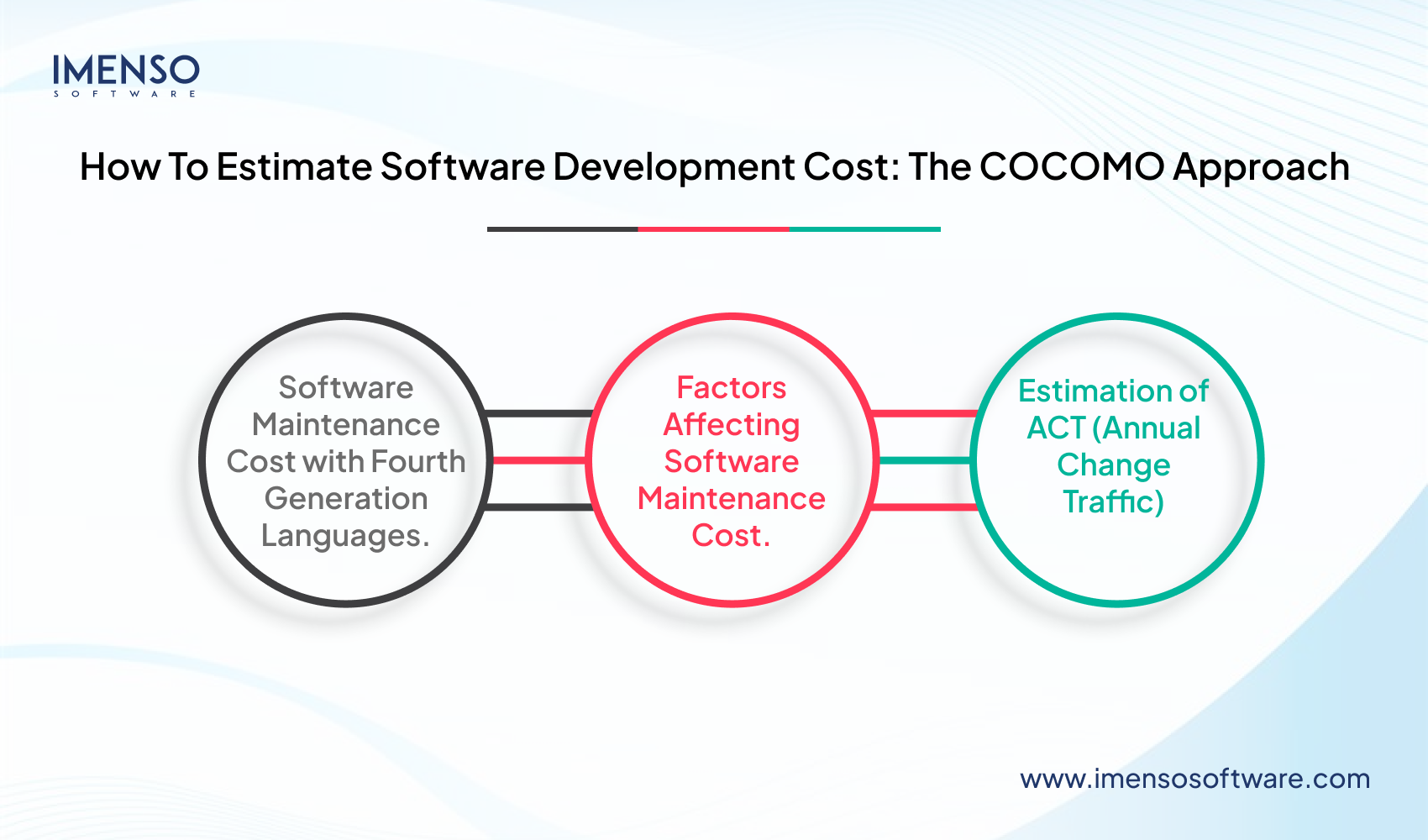
The new COCOMO approach factors three things:
- SMCE with Fourth Generation Language Environment
- ACT (Annual Change Traffic)
- Technical and Non-Technical factors that impact the maintenance cost.
Let’s look closely at each of them.
1. Software Maintenance Cost with Fourth Generation Languages.
Fourth-generation languages offer a novel approach to optimizing software maintenance. An issue that many face is being unable to create new solutions quickly. Fourth-generation languages resolve this problem. They allow rapid creation of new systems.
This, in turn, has increased the software that requires maintenance. It has been found that many firms choose to develop their systems rather than maintain them. Fourth-generation languages can impact maintenance in these ways:
- Developers can prevent simple hidden errors. This is because a fourth-generation language can manage specific software parts automatically.
- Many of these languages are linked to data management platforms. These are built within data dictionaries. This prevents the coder from misrepresenting the data.
- Most languages are self-documenting. Poor documentation is the main cause of maintenance-related issues.
- The languages make the program easier to understand. So, a third person can easily maintain it.
- Most of these languages do not permit poor program constructs. Thus, there are fewer chances of having trouble later.
2. Factors Affecting Software Maintenance Cost.
Two factors impact the maintenance cost of software.
Technical Factors
Ability of the Maintenance Team
Software maintenance requires a good amount of team training. If the members keep changing their positions, the effort massively goes up. The member’s experience also affects maintenance tasks.
Complexity of the System or its Part
The system or its parts can have a simple interface. You can implement them easily. But they can also be complex. It affects the overall effort.
Quality of Documentation
Poor code documentation proves costly. It makes it hard to resolve issues in the software. Documentation quality can make or break maintenance efforts.
Quality of Testing
Robust testing can reduce many errors. This lowers the maintenance effort and its cost. Contrarily, subpar testing increases the cost and the effort.
Software Life Span
Software with a longer lifespan has higher maintenance needs. One with a shorter span takes up less effort. It directly impacts the cost.
Code Quality
Spotting issues in unstructured code is hard. It influences the cost of software maintenance
Software Application
It means the area where the user employs the software. Every system has certain features related to its work.
Complexity of the Interface
Is the interfacing of the parts complex? It will increase the maintenance expenses of part-based systems.
CASE Tools
This refers to computer-aided software engineering. These tools help developers work through complex processes. CASE tools support various tasks. They can be simple editing tools. Alternatively, they can also be complex ones that support the system’s lifespan.
Non-Technical Factors
Level of Comprehension
When a developer tries to maintain a system created by another expert, they must understand it properly. If they find it tough to comprehend, it limits maintenance.
Likelihood of Occurrence
Every scenario during a software’s lifespan will have specific chances of occurrence. Teams must assign every scenario a probability.
Modernity of the Tech Stack
Maintenance risk and cost can go up based on the newness of the tech stack. The level at which new technology emerges also influences it.
Business Maturity
One can base a firm’s maturity on its quality certification. CMM level defines a minimum guarantee for the development’s quality. A reputable business has skilled staff. They have processes to spot and correct defects. It lowers the dependence on experts. This, in turn, optimizes maintenance costs.
3. Estimation of ACT (Annual Change Traffic)
For estimating software project cost for maintenance, Boehm used ACT. It is the fraction of the source guidelines of the product. These are the rules that change during the year. This change can come through addition or alteration.
You use the ACT quantity along with the development effort in months. This lets you find the yearly software maintenance costs.
To estimate the ACT of your software, begin by defining specific features of the product. These functions should critically affect ACT. Review and assess the features regularly. It lets you spot crucial software attributes.
You can then assign a weight to each one. Now, you can properly address every characteristic based on the ACT data. Every software will have two options for every attribute. It can have it or not.
Software Maintenance Models to Optimize Cost
Maintenance is the only sensible route to keep the software aligned with the evolving business needs.
Companies desire incremental changes to their product. The aim is always to cut costly, time-intensive development efforts. A software maintenance model offers a way to improve the software without a full overhaul.
What Should You Know Before Choosing a Maintenance Model
To optimize the maintenance cost of software, you must execute the tasks systematically. Choose maintenance based on your project’s scope. Then, pick a model that most benefits your project.
Here’s what you should consider:
- If the impact scope is above 25% of the code, assess the age and structure of the current app. Here, opting for restructuring will be the best strategy.
- If the code changes are less than 15%, basic maintenance is usually enough.
- If the estimate is between those two figures, consider your time and budget to decide.
Software Maintenance Models
Once you are clear on the above, choose from these maintenance models.
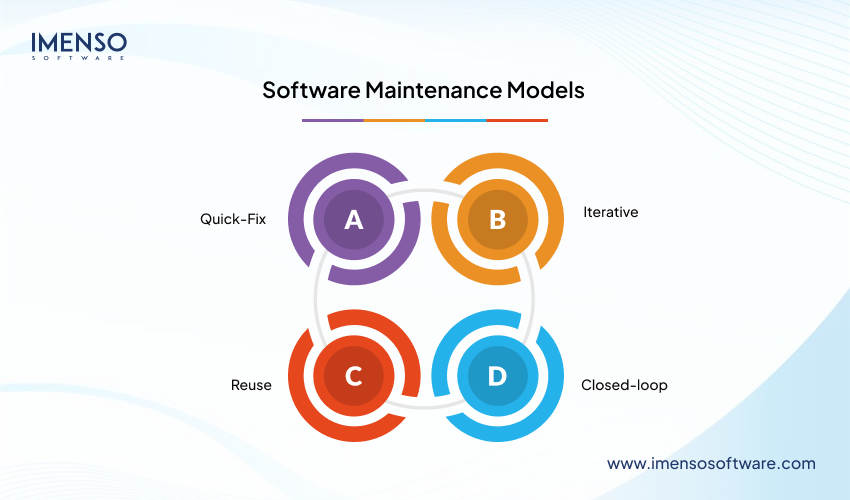
a. Quick-Fix
Here, you make a change without factoring in potential future work. It is suited for emergency maintenance only. Ideally, you must create a team dedicated to crisis maintenance.
When using this model, specify changes with code comments. Also include a change ID. Input these changes into a maintenance history. It must document the reason for these changes and how they were done.
b. Iterative
The iterative model is ideal for a small-scale app revamp. You can also use it for planned maintenance. In this model, only the development team works. However, the model has a risk. It doesn’t include business justifications. So, the team doesn’t know if they will need to make bigger changes in the future.
This model follows the same steps as a full software project. It is perfect for changes made to confined app targets.
c. Reuse
This model includes the mandate to develop and reuse software parts. The parts can work in various apps or places. The aim is to create reusable parts. These can then be offered to all projects.
It’s critical to consider the parts of an existing app for reuse. You can make changes to them or add new ones. Operate within the bigger framework of the business with the reuse model. Avoid introducing much code specialization. This will prevent the model’s use.
d. Closed-loop
Closed-loop is suited for planned maintenance. It’s also ideal for an app upgrade. The team of developers put forward the suggestion. It’s crucial to validate the case before working.
In a closed loop, work begins through iterative model flow. It ends when the team assesses the changes in the software. They then propose any extra work to enhance the software. This begins another round of changes.
Based on your unique needs, you can follow one or more maintenance models.
Relative Cost Comparison
| Model | Upfront Cost | Long-Term Cost | Predictability | Risk of Accumulating Technical Debt |
| Quick Fix | Low | High | Low | Extremely High |
| Iterative | Medium | Medium | High | Average |
| Reuse | Medium | Low | Medium | Low |
| Closed-Loop | High | Low | Extremely High | Extremely Low |
Ways to Reduce the Cost of Software Maintenance
Software maintenance costs can reach up to 90 percent of the software’s lifecycle expenses.
Undoubtedly, optimizing costs is critical to running profitably. Below are some effective ways to cut costs.
Focus on Preventive Maintenance
Identifying issues before they occur prevents costly repairs. AI-based monitoring tools help you catch such problems early. It will let you spot alarming trends. Thus, you’ll never face a crisis situation.
Choose Quality Software Development
High-quality code is easy to maintain. It remains majorly free from bugs. Ensure that your team sticks to the best coding practices. There should be robust documentation to enhance maintainability.
Automate Repetitive Tasks
Automating frequently occurring tasks helps optimize your workflows. It frees up precious resources. If you continuously face similar requests, deploy a chatbot. It frees up response times and offers round-the-clock support. Another great option is centralized logging. It lets you swiftly trace issues to their root cause. Thus, it minimizes resolution times.
Optimize Your Infrastructure
Minimize downtime by optimizing your infrastructure. Set it up so it automatically directs workloads to the appropriate servers. It will also restart failed containers and replace defective parts automatically. As a result, your operations will run smoothly.
Thinking Ahead: Shaping Software Success with Proactive Maintenance
It’s crucial to account for the cost of software maintenance before beginning any project. Hopefully, you are now aware of everything that goes into it. It will help you make better decisions when it comes to budgeting for your software’s maintenance. Like a well-tuned engine, prioritizing software maintenance will ensure that your software stays up-to-date, secure, and meets the changing needs. It will help your system remain robust and achieve lasting success.
Frequently Asked Questions
- How do you estimate the maintenance cost of the software?
You can calculate software maintenance costs based on various aspects of the product. These are the software performance, updates, and ongoing support. Factors like the product’s complexity and its code, updates, and the tech stack used impact the cost.
- What is the industry standard for software maintenance fees?
The industry criteria fall between 15% to 25% of the actual software license cost/year. The fees cover patches, updates, bug fixes, and more. It ensures that the solutions remain workable.
- What is covered in software maintenance?
Software maintenance includes changing the product in any way so that it meets users’ demands. It’s done after the product is available for use. The process improves the usability of the software.
- How does the architecture impact software maintenance costs?
Good architecture results in quality code. It is easier to maintain. Infrastructure designed with scalability in mind can handle more users. It promotes the addition of new features without much maintenance cost.
Want more information about our services?


Similar Posts

10 Best NodeJS Frameworks for Building Robust Web and Mobile Applications
Are you grappling with the challenges of web and mobile app development, yearning for effective solutions to build robust and scalable applications that offer exceptional user experiences? Look no further. The answer lies within the realm of Node.js and its powerful arsenal of frameworks. Imagine yourself faced with a deadline, entrusted with creating a web […]...
![Cost to Build a FinTech App [A Detailed Guide]](png/cost-to-build-a-fintech-app.png)
Cost to Build a FinTech App [A Detailed Guide]
Figuring out the cost to build a fintech app in 2025? You need to know if you need to make a simple app with basic features or a medium app with moderate features. Also, you can think of a complex app with very advanced features. These fintech apps have revolutionized the industry. This is because […]...

What Is CMS? And Why Your Website Must Have One
You can make a website in 10 minutes now, thanks to modern CMS platforms. And it’s not just a marketing campaign to entice business owners into trying a new tool. Building websites has never been easier. There are a vast number of no-code website builders available on the internet for free. You can create a […]...