How Much Does It Cost to Build a Healthcare Practice Management Software
Don’t you think that running a healthcare practice sounds simple on paper? But, anyone in it knows, it’s a full-time job to manage appointments along with handling billing and dealing with insurance. This also involves storing patient records and ensuring compliance.
Do you know the global practice management system market size is growing at a CAGR of 10.19% from 2025 to 2030?
That’s why more clinics and health teams are turning to Healthcare Practice Management Software. It helps organize the backend so doctors and staff aren’t drowning in admin work all day.
If you’ve ever thought about building your system, chances are the first thing you’ve wondered is, How much is this going to cost?
And the honest answer? It depends on what you need and who’s building it. Besides this, how complex it is and how fast you want it done are also important. So, we’ll break it all down and understand how much it costs to build a healthcare practice management software.
What Is Healthcare Practice Management Software?
Let’s keep it simple. Healthcare Practice Management Software (HPMS) is what keeps your clinic or hospital running smoothly behind the scenes.
It helps you do all the non-clinical stuff like:-
- Scheduling appointments
- Registering patients
- Sending reminders
- Managing bills and insurance
- Tracking reports and admin tasks
- Keeping everything organized and secure
Basically, it’s the digital assistant your practice needs to stay efficient without burning out your team.
Now, HPMS is different from EHR (Electronic Health Records). It focuses on clinical data that includes test results and prescriptions, as well as treatment notes. HPMS focuses on running the business side—things like workflow, operations, and patient flow.
Whether you’re a solo practitioner, a multi-location clinic, or a remote care startup, HPMS can take a huge load off your shoulders and save your team hours every week.
What Affects the Healthcare Practice Management Software Development Cost?
So now that we know what HPMS does, let’s get into what drives the cost of building a healthcare practice management software.
Spoiler: it’s not just about how many features you want. The price can vary significantly based on the complexity of your workflows and the level of customization required. It also includes who is building it and the degree of security your system needs to have.
Let’s break down the main things that impact the final price tag.
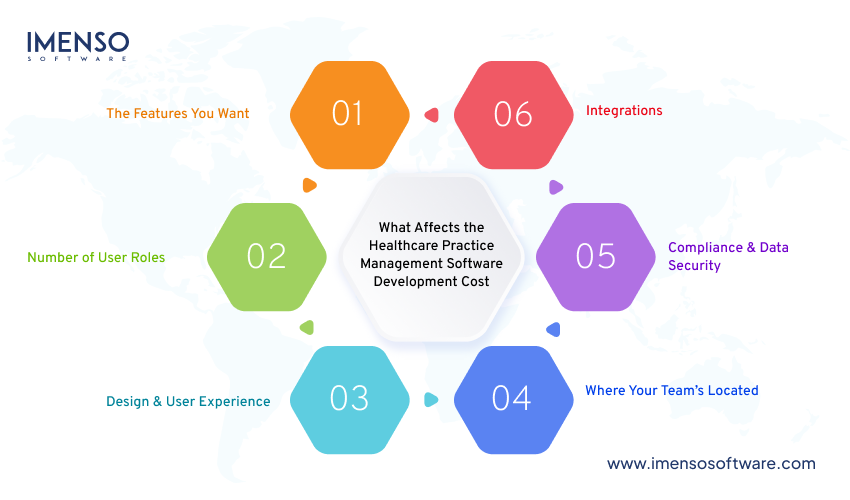
1. The Features You Want
The more your software needs to do similarly, the more time and cost it takes to build a healthcare practice management software. A simple scheduling and billing tool? That’s on the lower end. But if you want telehealth, EHR integration, smart reports, or real-time analytics? That’ll push things up.
2. Number of User Roles
Does your system need to support different types of users, such as front desk staff, doctors, nurses, patients, and even billing teams? You need each system to have its own layout, permissions, and flow.
3. Design & User Experience
Want something that looks clean and feels easy to use for your users? Or, are you planning for an interface that works across phones and tablets and desktops? That takes extra design effort. A bad UI will cost you way more support and frustration later.
4. Where Your Team’s Located
Costs vary wildly based on your development team’s location.
- US or Canada: $120 to $250/hr
- Europe: $60 to $120/hr
- India, Southeast Asia: $25 to $60/hr
Even with the same skills, the location can double or triple your cost.
5. Compliance & Data Security
Healthcare applications dealing with sensitive data need to be compliant with HIPAA, HL7, and GDPR as required. It probably expects to spend more on encryption, access control, and legal reviews.
Read our blog to know how much does a HIPAA compliant app development cost.
6. Integrations
Need to connect with labs and pharmacy systems or insurance portals? It takes more dev time and sometimes extra licensing costs, as per the choice of platforms.
Each of these factors adds a layer to your total cost of practice management software for healthcare. Once you know which ones matter most for your practice will help you prioritize and budget smarter.
Feature Breakdown With Cost Estimates
Let’s talk about real numbers. Here’s a breakdown of the most common features found in healthcare practice management software. Also, you will get to know how much each might cost to build in 2025.
Remember, the complexity of your software is directly proportional to the increase in the final cost of practice management software for healthcare.
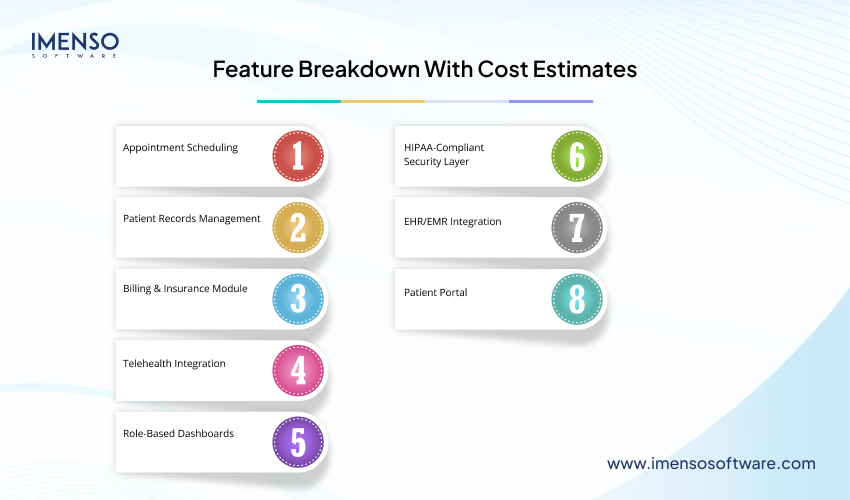
a. Appointment Scheduling
Let patients book and reschedule visits. Syncs with staff calendars and sends reminders.
The cost will be $5,000 to $10,000.
b. Patient Records Management
Stores patient details, history, allergies, prescriptions, and visit logs. Can be basic or deeply connected with EHR.
The cost will be $8,000 – $15,000.
c. Billing & Insurance Module
Handles invoicing, insurance claims, co-pays, and payment tracking. It can also detect errors or automate reminders.
The cost will be $10,000 – $25,000.
d. Telehealth Integration
Secure video calls, session notes, and digital prescriptions all in one place. A must-have for hybrid care.
The cost will be $10,000 – $20,000.
e. Role-Based Dashboards
It offers customized views for doctors and their admin staff, along with receptionists, and with billing teams, so everyone sees only what they need.
The cost will be $3,000 – $8,000.
f. HIPAA-Compliant Security Layer
This includes encryption and access control. Along with this, these include secure backups and audit logs. Essential if you’re handling protected health info.
The cost is $10,000 – $30,000.
g. EHR/EMR Integration
Allows syncing clinical records from existing electronic health systems into your HPMS.
The cost is $12,000 – $30,000.
h. Patient Portal
Let patients log in, view their records, book appointments, and message providers.
The cost is $6,000 – $12,000.
You don’t need everything right away. A smart approach is to build a lean Minimum Viable Product with just the essentials. Then add more features once your team and patients start using it.
How Long Does It Take to Build a Healthcare Practice Management Software?
If you’re thinking about building your healthcare practice management software, one of the first things you’ll want to know is, how long is this going to take?
It depends on how complex your system is. But here’s a general breakdown of the process and how much time each stage takes:-
1. Discovery & Planning – 2 to 4 weeks
This is where you figure out what you need. It involves business analysis, defining features, creating workflows, and mapping out priorities.
2. Design – 3 to 6 weeks
Your UX and UI designers create the look and feel of your software. This includes screens, navigation, and how everything will work across devices.
3. Development – 3 to 8 months
This is where your features come to life. Developers build the backend systems and frontend interfaces also APIs, or integrations, and all the logic.
4. Testing – 2 to 4 weeks
Now it’s time to find bugs and fix them. You’ll also test how the system works on different devices with real users and under stress.
5. Launch & Post-Go-Live Support – 2 to 4 weeks
Your HPMS is deployed, but the team sticks around to monitor performance, fix any post-launch issues, and help you onboard users.
So overall…
A simple system with basic features could take around 4 to 6 months. A more advanced, enterprise-level HPMS can stretch to 9 to 12+ months.
It’s not just about speed, it’s about building something solid that works smoothly and can grow with your clinic.
Custom vs. Off-the-Shelf – What’s Better?
You’ll hit a big question when you start exploring HPMS options. Should you build your own or use something that’s already out there?
Although there’s no one-size-fits-all answer and it depends on what your clinic needs today and how you plan to grow in the future.
Here’s how both options stack up.
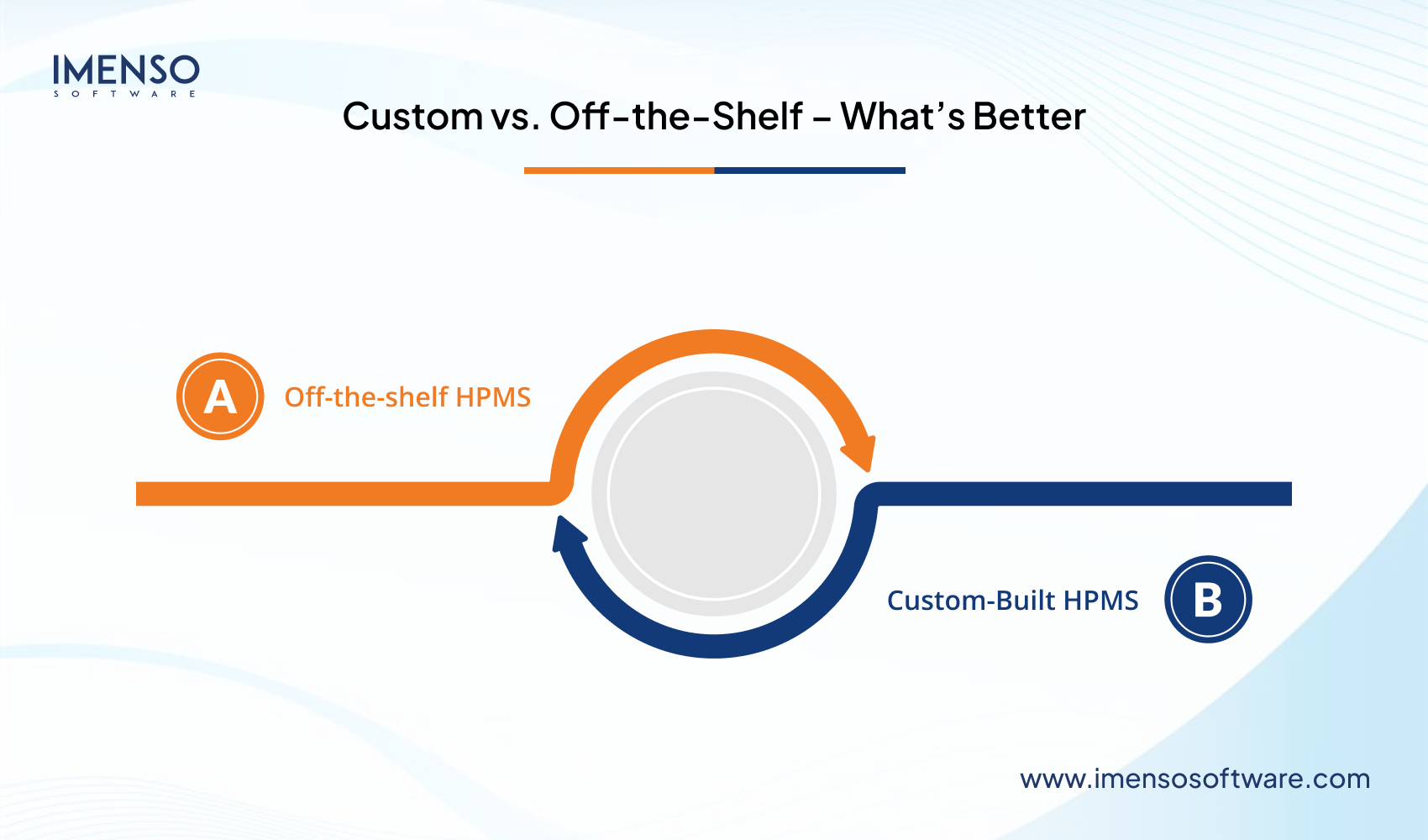
a. Off-the-shelf HPMS
Pros:
- Fast to get started
- Lower upfront cost
- Comes with core features like billing and scheduling also EHR support
- Regular updates and support from the vendor
Cons:
-
- You pay monthly forever
- Can’t always customize it to your workflow
- Integration with other tools is hit or miss
- You’re limited by their roadmap and features
b. Custom-Built HPMS
Pros:
-
-
- Built exactly for how your clinic works
- You own the code—no licensing fees
- Easily integrates with your tools and EHRs, along with labs also billing partners
- Scales and evolves with your practice
-
Cons:
-
-
- Higher upfront cost
- Takes time to plan, build, and launch
- You’re responsible for updates and maintenance (unless you outsource that)
-
So, Which One’s Right for You?
Consider that an off-the-shelf tool might do the job just fine for a small clinic with basic needs and a tight timeline.
Are you growing fast and require special features or want full control? A custom healthcare practice management software is an investment that pays off long-term in both efficiency and ownership.
Hidden Costs of Healthcare Practice Management Software Development People Miss
When budgeting for healthcare practice management software, most clinics focus only on the upfront development cost. But there are a few sneaky extras that can catch you off guard if you’re not prepared.
Here’s what to look out for:
-
-
-
Maintenance & Support
-
-
Once your healthcare practice management software is live, it’ll need updating, bug fixes, and small tweaks over time. Most teams set aside 15–20% of the original dev cost annually for maintenance.
-
-
-
Hosting & Infrastructure
-
-
You’ll be paying monthly for cloud services like AWS or Azure, unless you’re running it on local servers, which is rare now.
Typical range: $200 to $2,000 per month, depending on your usage.
-
-
-
Staff Training
-
-
You’ll need to train your team to use the system properly, especially if it’s custom. Whether that’s video walkthroughs or live sessions, factor in $1,000 to $5,000 for this.
-
-
-
Data Migration
-
-
If you’re switching from spreadsheets or another HPMS, moving patient data safely and correctly is no small task. This could cost $2,000 to $10,000, depending on how much data you’ve got and where it’s coming from.
-
-
- Ongoing Compliance Checks
-
Rules like HIPAA or GDPR don’t stay static. Your system needs to stay updated with the latest regulations. This might mean minor development updates or audits down the road.
Planning for these from the start will save you stress and money later.
Expected ROI & Long-Term Benefits from Healthcare Practice Management Software
Initially, building your healthcare practice management software might feel like a big investment up front, but the long-term payoff is real.
Here’s how custom healthcare practice management software starts returning value:-
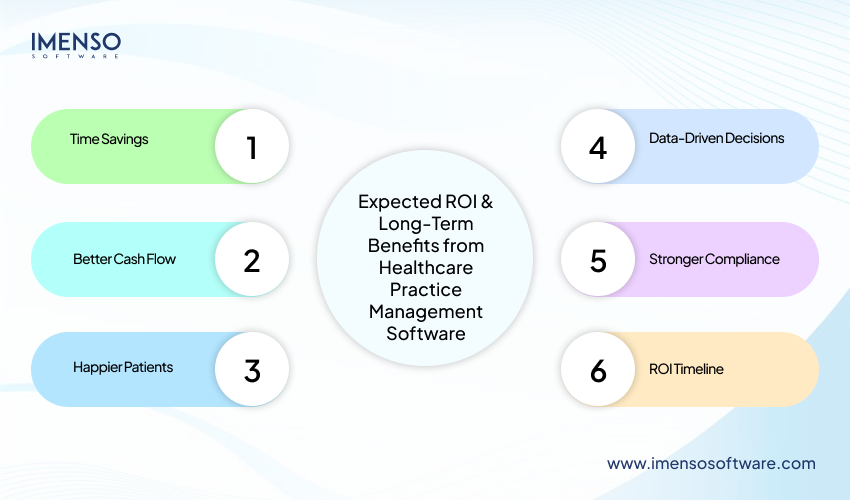
1. Time Savings
Once you automate scheduling, billing, and reminders implies you spend less time on manual tasks and more time helping patients. That alone can free up hours every week.
2. Better Cash Flow
Payments become quicker and smoother with fewer billing errors and faster claims processing, also with built-in reminders for patients.
3. Happier Patients
When things run smoothly and fewer wait times, easy check-ins, and clear billing, your patient experience gets better. And a better experience means better retention.
4. Data-Driven Decisions
Custom dashboards let you track the right metrics and no more guesses. You’ll see where time and money go and how to improve operations.
5. Stronger Compliance
You reduce the risk of costly penalties or breaches, when your system is built with compliance baked in.
6. ROI Timeline
Most clinics that invest in a well-built HPMS start seeing a return in 12 to 18 months, especially if the software replaces multiple disconnected tools.
Bottom line, custom healthcare practice management software doesn’t just help you run smoother. It helps you grow smarter.
Healthcare Practice Management Software Cost Breakdown by Clinic Size
The size and structure of your practice play a big role in how much you’ll need to spend. A solo clinic has very different needs (and budget) compared to a multi-location hospital group.
Here’s a quick breakdown to give you a ballpark idea:-
-
-
-
Solo or Small Practice
-
-
You probably need just the basics like scheduling and billing. Also, maybe patient records and maybe a simple patient portal.
Estimated cost: $40,000 – $70,000
-
-
-
Mid-Sized Clinic or Group Practice
-
-
Now you’re adding more users or more roles and features. Such as dashboards, insurance claims, or lab integrations.
Estimated cost: $80,000 – $150,000
-
-
-
Enterprise or Multi-Location Setup
-
-
You’re looking at complex workflows and multi-role access. Also, it may have deep integrations (EHR, labs, pharmacies) and high-end security with scalable cloud infrastructure.
Estimated cost: $150,000 – $300,000+
These ranges can shift depending on how lean or loaded you want in your first version to be. Many practices also start small and grow the system over time.
Ready to Build Smarter Software?
Building your healthcare practice management software might not be cost-effective, but it’s an investment in smoother operations, happier patients, fewer errors, and more time for what matters.
The right HPMS can save you serious time and money down the line. You are in profit even if you’re a small clinic just starting or a growing group practice. The key is to build smart—start with what you need now, then scale as you grow.
If you’re still figuring out whether to build custom or just want help estimating your costs, our team at Imenso Software is happy to chat. We’ve worked with healthcare teams across the globe to build tools that fit the way they work.
FAQs
1. Is it cheaper to buy a HPMS instead of building one?
Off-the-shelf tools are cheaper upfront and faster to start using. But building your own can be more cost-effective in the long run, is good for custom features, or you want long-term savings.
2. How do I know if my clinic needs custom software?
If your current tools feel limiting and disconnected. Or you can’t handle your workflow the way you want. It’s a sign you’ve outgrown them, and custom software gives you control and flexibility tailored to your practice.
3. Can I build a HPMS in phases?
Many clinics start with just scheduling and billing. Later, they add features like telehealth or reporting. It is a smart style while working with a tight budget or timeline.
4. What’s the biggest cost factor when building HPMS?
Features are usually the biggest driver. More complex features like EHR integrations or HIPAA-level security add time and cost. Design and compliance also play a big role.
5. How long does it take to build a HPMS from scratch?
For a basic version, you’re looking at around 4 to 6 months. For a more advanced, fully integrated system, it can take 9 to 12+ months.
6. What ongoing costs should I expect after launch?
Plan for cloud hosting, system maintenance, updates, staff training, and occasional compliance reviews. These costs are often overlooked, but they’re essential to keeping your software running smoothly.
Want more information about our services?


Similar Posts

Telehealth Development- Transforming the future of healthcare
Telehealth is transforming how we get healthcare, and it is at the forefront of that shift. Telehealth, also known as telemedicine or e-health, is revolutionizing the healthcare industry by using technology to connect patients with medical professionals virtually. With the increasing demand for healthcare services and the limited resources available, telehealth has become an important […]...

AI in Healthcare – Transforming the Future of Medicine
Quick Summary The AI in healthcare industry is unlocking possibilities we couldn’t have imagined a decade ago. It analyzes scans in seconds, predicts patient risks before symptoms appear, and helps design life-saving drugs with generative AI in healthcare. This amplifies their skills to enable more accurate, affordable, and personalized care. Artificial Intelligence is quietly […]...

Top Use Cases of Data Visualization Dashboards in Healthcare
The human eye is naturally drawn to pictures more than text lists. Therefore, it is not an exaggeration to claim that data science visualizations in healthcare are essential for saving lives. The healthcare sector is being shaken up by big data. Simply put, data visualization is the practice of displaying data graphically, such as through […]...