HIPAA Compliance for Software: A Practical Guide

Security breaches hit all types of businesses. The hardest hit of them all are the healthcare providers and their patients. In 2024, over 500 patient records were compromised. More than 20 healthcare providers had to pay hefty penalties for HIPAA violations. In light of this, the current situation seems shocking.
HIPAA audits conducted for the past few years show that only 6% of organizations have all relevant technical checks for HIPAA-compliant app development. It means very few businesses actually protect ePHI (electronic patient health information).
It is high time for software firms in the healthcare sector that manage or have access to identifiable health information of patients to realize the importance of being HIPAA compliant.
This blog will serve as an actionable guide for HIPAA-compliant app development. We will cover all the essential safeguards and best practices to develop an app that positively serves you and your patients.
Meaning of HIPAA-compliant App Development
HIPAA-compliant app development means that your app fulfills the technical and physical checks of the HIPAA Security Rule. It means that the app can only use or disclose ePHI to the extent that the HIPAA Privacy Rule permits. The Security Rule ensures confidentiality, integrity, and availability of the patient data via robust administrative, physical, and technical safeguards.
What Is the Subject Matter?
Any data in your software related to a person is subject matter. They include:
- Software handling patient records or health data. It must follow HIPAA.
- AI and IoT breakthroughs extend compliance to remote monitoring and analytics.
What Is a Covered Entity?
Covered entities are companies handling healthcare functions under HIPAA. These include:
- Clearinghouses for billing and claims
- Health plans and insurance companies
- Healthcare providers
- Business associates. These are software vendors, cloud providers, and IT consultants
- Software Requiring HIPAA Compliance
- Below are the types of software that require HIPAA compliance:
- Electronic health record (EHR)
- Electronic medical record (EMR) systems
- AI-powered diagnostics or predictive analytics tools that process patient data
- Telemedicine systems supporting video consultations and ePHI sharing
- Remote patient monitoring systems that use IoT devices
- Healthcare management systems. Examples include patient portals and hospital management platforms
- Medical billing and coding software
Five Main Rules of HIPAA-Compliance
HIPAA-compliant mobile app development demands the protection of patient data. The protection should be present throughout the storage, transmission, and access. This is covered in the 5 HIPAA rules.
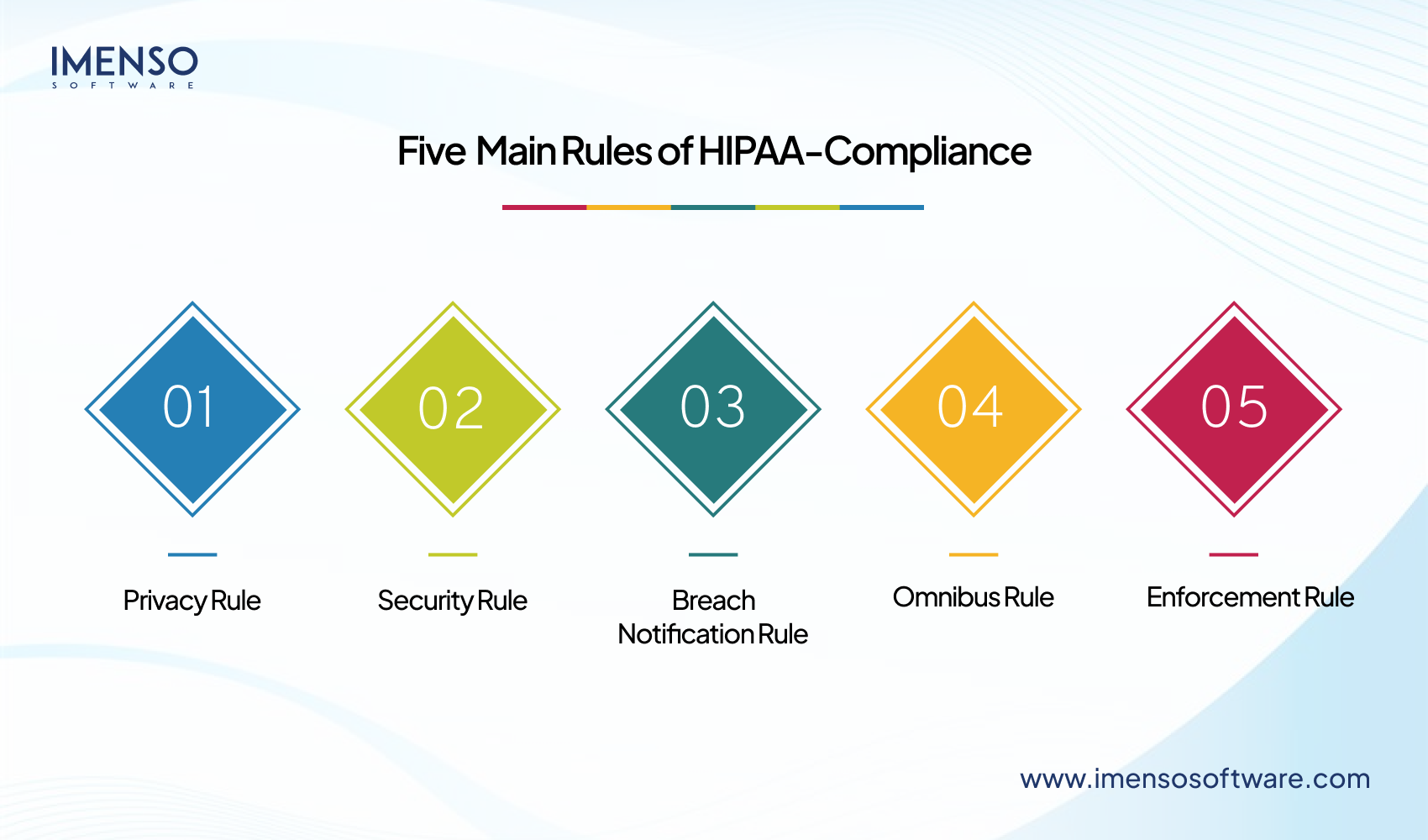
1. Privacy Rule
The Privacy Rule outlines the rights patients have over their health data. This rule is applicable to all identifiable health data.
Healthcare software handling PHI and ePHI must ensure:
- Patient must be able to access, examine, and request copies of their PHI
- Sharing of PHI is only applicable in a few legal or research circumstances.
- Disclosure of patient data requires their consent.
- A privacy official must supervise compliance. They must ensure adherence to privacy policies.
- If PHI disclosure occurs, it should happen under strict protocols.
2. Security Rule
HIPAA-compliant app development agencies should be aware of the Security Rule. It protects PHI from breaches and illegal access. Below are its key safeguards.
Perform frequent risk analyses to find security gaps.
- Limit access to ePHI on the basis of job role and operation.
- Staff should get training on security practices and incident response plans.
- Only authorized staff can access physical systems with ePHI.
- Define rules for the secure use, removal, or reuse of devices with ePHI.
- Encrypt ePHI during storage and transmission.
- Use MFA to prevent illegal access.
- There must be platforms that implement audit controls to record system activity involving ePHI.
3. Breach Notification Rule
The Breach Notification Rule lays out the procedure to follow in case of a breach of PHI.
- Affected patients must receive written notice within 60 days of discovering the incident.
- If the breach affects over 500 patients, the organization must alert the media. It must issue a public announcement
- Large-scale breaches must immediately be reported to the Department of Health and Human Services. Minor breaches can be reported yearly.
- Business associates must alert covered entities of breaches. They should adhere to the same timeframe.
4. Omnibus Rule
The Omnibus Rule gives clarity on the examination of the HIPAA Privacy and Security Rule breaches. It also decides on how to penalize the responsible party. Below is an overview of this rule for HIPAA-compliant app development businesses.
- Businesses must perform frequent audits to spot compliance loopholes
- In case of non-compliance, the company must come up with corrective action plans.
- The harshness of penalties depends on the negligence level.
- Covered entities should ensure their business associates follow HIPAA rules. Non-compliance by the associate can cause the covered entity to face penalties.
5. Enforcement Rule
The Enforcement Rule defines the rules and fines for violations of HIPAA’s Privacy, Security, and Breach Notification rules by covered entities and Business Associates. Here are its key tenets.
- All covered entities and business associates must maintain HIPAA requirements in safeguarding PHI and ePHI
- A violation of unsecured PHI must be reported to the impacted patients. It must also be reported to the Department of Health and Human Services and the media (if applicable)
- Disclosure and marketing limits restrict the use of PHI for marketing or sales without clear patient permission.
- BAAs must include clauses that impose HIPAA’s security standards.
- The rule brings forth a tiered penalty plan. It is based on the level of negligence. The plan imposes fines and sanctions on entities that do not comply with HIPAA’s standards.
Technical Safeguards to Make Your Software Compliant With HIPAA
Technical safeguards are technology-based security measures and related procedures that protect ePHI and control access to it. They include agreements with healthcare entities, stringent access controls, and more. Below are the key measures every HIPAA-compliant software solution should have:
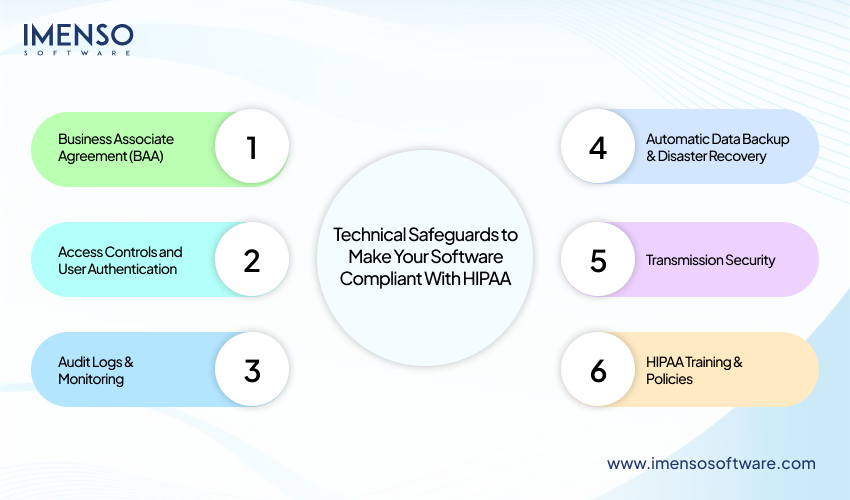
1. Business Associate Agreement (BAA)
A HIPAA-compliant software firm must sign a BAA with covered entities. This is the healthcare company. BAA outlines the vendor’s duty to protect PHI. In the absence of a BAA, the software is not HIPAA compliant.
Software agencies that offer BAA usually list so on their website or other critical documents. Through it, they let you know about their suitability for healthcare companies.
2. Access Controls and User Authentication
Access means “the ability or the means required to read, write, modify, or communicate data or otherwise use any system resource. Access controls grant users the rights to access and perform functions within information systems, apps, programs, or files. As per the Access Control standard, a covered entity should implement technical policies and plans for electronic information platforms. These procedures will maintain ePHI to allow access only to the people/programs with the access rights. Four implementation specifications are linked with the Access Controls standard.
a. Unique User Identification
It states that a covered entity must assign a unique name and/or number for identifying and tracking user identity. User identification determines a particular user of an information system. A unique user identifier lets you track specific user behaviour when they are using that information system. So, they can be held accountable for what they do on the systems with ePHI.
The company must determine the best user identification strategy as per its workforce and operations. A few questions to consider include
- Does every staff member have a unique user identifier?
- What is the present format for unique user identification?
- Can the unique user identifier be used to monitor user activity within information systems that have EPHI?
b. Emergency Access Procedure
The company must define policies to obtain necessary ePHI during an emergency. It’s crucial to identify the situations that need emergency access to a system that has ePHI. Staff should be trained in ways to access ePHI in these cases. Some questions to consider are:
- Who needs access to the EPHI in the case of an emergency?
- Are there policies and plans in place that give the right access to ePHI in these situations?
c. Automatic Logoff
An organization should implement electronic procedures that stop a session after a specific time of inactivity. Automatic logoff is a great way to prevent unauthorized users from accessing ePHI on a system when it is left unattended for long. Essential questions to consider are:
- Do current information systems have an automatic logoff function?
- Is the automatic logoff feature active on all systems with access to ePHI?
d. End-to-End Encryption
This specification states to implement a mechanism to encrypt and decrypt health data. Encryption involves encoding an original piece of text into an encoded message. Encrypted data is less likely to be decrypted by unauthorized users.
Some questions to consider include:
- Which EPHI should be encrypted and decrypted to prevent access by persons/apps without access rights?
- What encryption and decryption controls are appropriate to implement to avoid access to EPHI by programs/people without access rights?
3. Audit Logs & Monitoring
The Security Rule does not determine the data that audit controls should collect. The organization should conduct its risk analysis. It should consider its own IT infrastructure to identify the right audit controls for systems using ePHI.
The questions below will prove helpful.
- What audit control mechanisms are appropriate to implement to record and assess activity?
- What are the audit control features of systems with ePHI?
- Do the audit controls implemented let the company adhere to the policies developed to comply with the implementation specification for Information System Activity Review?
A software compliant with HIPAA laws should:
- Maintain comprehensive audit logs of all staff engagements with PHI.
- Offer real-time tracking and alerts for suspicious activity.
- Support log retention for six years.
4. Automatic Data Backup & Disaster Recovery
Data loss protection is another crucial HIPAA requirement. Companies must fulfil it to safeguard PHI from disaster or loss. A HIPAA-compliant software should have:
- Automated encrypted backups to ensure that the latest PHI is retained in case of a security attack.
- Comprehensive disaster recovery plans to restore data in any event that compromises data access.
- Geographically redundant storage so that PHI is stored on separate servers in different locations. So, if one server is damaged, patient data can still be accessed.
5. Transmission Security
This standard requires an organization to implement security measures that protect against unauthorized access to ePHI transmitted over an electronic communications network. The company must assess its current methods to transmit ePHI. Then, decide the relevant security measures to protect ePHI as it is transmitted. There are two implementation specifications for this:
a. Integrity Controls (Addressable)
The covered entity must implement security measures to ensure that electronically transmitted ePHI is not improperly altered during transmission. Network communications protocols are used to protect the integrity of ePHI. They ensure that the same data is being sent and received. Below are some questions that help determine which integrity controls to consider.
- What security measures are currently used to safeguard ePHI during transmission?
- Has the risk analysis identified situations that may cause alteration to ePHI by unauthorized sources during transmission?
- What security measures can be used to protect EPHI in transmission from unauthorized access?
b. Encryption (Addressable)
This specification states to implement a control to encrypt ePHI when appropriate. Several encryption technologies are available for companies. But the sender and receiver must use the same technology when data is being transmitted. According to the Security Rule, an organization can use the encryption method best suited to its needs.
Below questions will help determine the right course of action.
- How does the business transmit ePHI?
- How often does ePHI transmission take place?
- Is encryption required to protect EPHI during transmission based on risk analysis?
- What methods of encryption will safeguard the transmission of ePHI?
6. HIPAA Training & Policies
It’s easy to compromise software whose users are not trained on how to use it. In other words, your staff must know how to spot suspicious activity and report it. For this, always choose software vendors that offer HIPAA compliance. They must provide cybersecurity training. Reliable vendors implement administrative controls. They can customize security policies to align them with your needs.
Best Practices for HIPAA-Compliant Application Development
To develop a HIPAA-compliant mobile app, you must consider various things. Below are some proven approaches to follow.
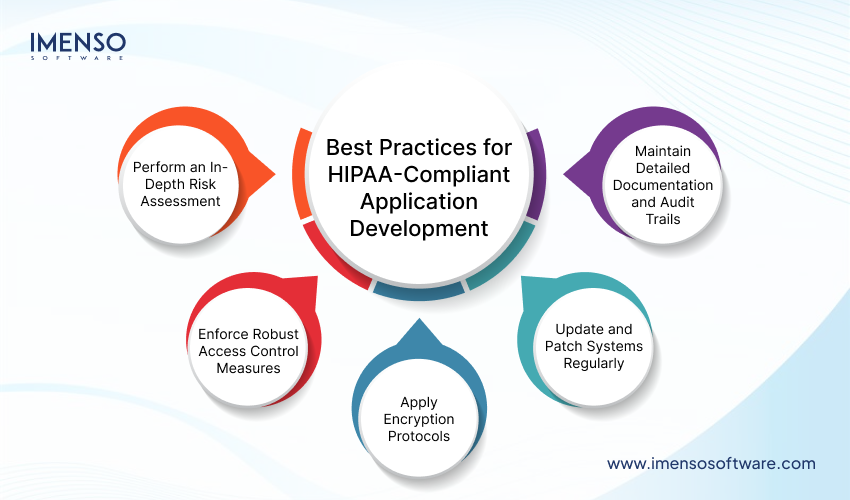
1. Perform an In-Depth Risk Assessment
Risk analysis lets you spot potential gaps. If unchecked, they can compromise patient data. Risk analysis should be comprehensive. It means that it should assess every aspect of development. From how data is fed to user management and transmission, you must examine everything. This will enable you to develop precise mechanisms for data protection.
2. Enforce Robust Access Control Measures
A trusted HIPAA-compliant app development company implements strong access control measures. They know it’s crucial for data security and privacy. Limit access to PHI based on user roles. Use authentication controls like MFA and password policies. Ensure that the system with PHI logs off automatically if it is idle for a long time.
3. Apply Encryption Protocols
Apps should use the best encryption safeguards. This is crucial for data at rest and data in transit. Encryption checks prevent illegal access to data. If the patient data falls into the wrong hands, it remains encrypted. Therefore, only the relevant party can make sense of it.
4. Update and Patch Systems Regularly
Security is a critical part of developing a HIPAA-compliant app. So, frequently update and patch the systems. Streamline this task by creating a plan for regular updates. Patch systems without delay. This will shield the software against new threats.
5. Maintain Detailed Documentation and Audit Trails
Maintaining detailed documentation and creating audit trails simplifies compliance procedures. Documentation should include every instance of compliance-related tasks. Audit trails should record all those who accessed PHI and what they did with it.
Steps to Create a HIPAA Compliant App
HIPAA-compliant app development requires you to adopt privacy-first thinking. The process can seem daunting. So, we have broken down the various steps below.
Perform a HIPAA Compliance Analysis and Requirements Assessment
Document every area where patient data enters, moves, or rests. Create comprehensive data-flow diagrams. Then, compare them against HIPAA’s Privacy and Security Rules.
Every data flow should align with the three safeguard categories:
- Administrative: Policies, plans, staff training, breach response action plan.
- Physical: Facility access controls, protocols to dispose device, and workstation security
- Technical: Encryption, audit logging, access controls, intrusion detection.
Select the relevant technology stack for HIPAA-compliant app development
- Backend Frameworks: Node.js, Spring Boot, and Django ensure robust access controls and encryption.
- Frontend Technologies: React Native, Swift, and Kotlin are suitable for a secure and responsive interface.
- Databases: PostgreSQL, MongoDB, and Google Cloud Healthcare API.
- Cloud Services: AWS, Microsoft Azure, and Google Cloud
Choose and prioritize features of a HIPAA-compliant app
A HIPAA-compliant app combines strong security with user-friendliness. The app has several distinct features. We have grouped them into three primary categories.
Security Features
Security is the topmost priority. The features below ensure that the app maintains user trust and legal standards.
- End-to-end encryption for data in both transit and at rest
- Two-factor authentication (2FA) for user access or login
- Role-based access control to restrict access to data by user role
- Audit logs that track all user actions and access to data
User-oriented Features
A HIPAA-compliant app is user-friendly. Healthcare providers and patients must be able to perform various tasks with ease. At the same time, the features should not sacrifice data privacy. User features include:
- Secure patient profiles with limited access to personal health data
- Encrypted messaging for sensitive patient-provider dialogue
- Appointment scheduling and alerts
- Secure telemedicine features for virtual consultations
Compliance Features
Compliance features maintain the integrity of the app’s data. They offer continuous protection for patients and doctors. These features are:
- Frequent data backups with recovery plans
- HIPAA-compliant external integrations and APIs
- User-managed privacy settings to control data sharing
- Security audits and risk analysis to maintain compliance
Establish User Roles and Access Levels Based on HIPAA Standards
Identify all user personas. This includes patients, doctors, billing staff, and admins. Give only the appropriate permissions to everyone. Capture them in an Access Control Matrix. Then, implement them in your authentication layer.
Automated onboarding and offboarding procedures. This keeps permissions current. So when roles change, your platform reflects it in real-time.
Build a Secure App Architecture
Break down your healthcare app into layers. These include presentation, business logic, and data access. Enforce encryption at each one of them. Isolate PHI workflows. It ensures that a vulnerability in one component does not affect the entire dataset.
Create threat models and data-flow sketches. This will help you learn and plan for the worst-case situations. Then, reinforce controls around these crucial paths.
Enforce Robust Authentication and Access Control Processes
Implement industry-standard protocols. These are OpenID Connect and OAuth 2.0. Turn on MFA for each user. Set up instant token revocation and session timeouts if suspicious activity is detected. Enable permissions across web, backend services, and mobile to remain consistent by centralizing policies in an Identity and Access Management (IAM) system.
Encrypt PHI Data at Rest and in Transit
Generate, rotate, and retire encryption keys on a fixed schedule. Use the Key Management Service (KMS) of your cloud provider for this purpose. Implement HTTPS/TLS 1.3 for every endpoint.
Encrypt database backups, snapshots, and exports with different keyrings. Automate these settings via infrastructure-as-code to reduce human error. It will offer consistent protection to your data.
Develop Comprehensive Audit Logging and Monitoring Functions
Set your code to log major events systematically with timestamps. Events include user logins, edits, record views, exports, and failed login attempts. Forward these logs in real time to a SIEM system. Set up alerts to get notified about suspicious patterns. These can be mass exports or off‑hours access. This will enable you to investigate promptly. Store logs in a secure location to use them in the event of an incident.
Create Breach Detection, Response, and Notification Workflows
Create a playbook outlining the following:
- Detection thresholds
- Containment steps
- Forensic investigation activities
- Notification timeframes
Automate wherever possible. For example, for triggering alerts from your SIEM, Isolate sacrificed credentials, and created notifications drafts for affected patients and for HHS.
Sign BAAs With All Service Providers
Build an inventory of all vendors that handle PHI. These include analytics systems, cloud hosts, messaging platforms, and email providers. Everyone should sign a BAA outlining their security responsibilities. Review these agreements annually or when you add new services.
Test, Audit, and Train Consistently to Maintain HIPAA-Compliance
Create a record of quarterly vulnerability scans, bi-yearly penetration tests, and policy reviews. This will let you maintain your app’s compliance with HIPAA. Revisit your controls and documentation after any data protection laws update.
The first step for HIPAA-compliant app development is choosing the right tech stack. Using the right technologies will help you safeguard confidential data most effectively. It will also speed up development. Next, you must equip the app with the essential features needed for compliance.
How Much Does a HIPAA-Compliant Application Cost?
The cost of HIPAA-compliant mobile app development ranges from $50,000 to $500,000. However, the exact price depends on various factors. These are:
- The app’s complexity
- Location of HIPAA-compliant app development company
- The category of users for whom the app is made. These mainly fall into general users, staff, and admin.
Having a dedicated app development budget is critical. You must find a team with expertise over HIPAA-compliant app development. Below are some options to consider.
In-House Team
This is one of the best options for healthcare facilities with a big budget. You must also have adequate time if you plan to hire in-house staff. Keep in mind that building such a team comes with its own set of risks. These include the absence of business analysis and project management. The only way to overcome them is to hire a team fully equipped with the skills and expertise to develop a HIPAA-compliant mobile app.
Freelancers
Hiring freelancers is a cost-effective approach. These developers often charge less than in-house staff. However, it has been seen that freelancers are often unable to leverage and manage resources for effective development. Many also lack the essential skill set for HIPAA-compliant app development.
Outsource to an App Development Agency
Outsourcing to a HIPAA-compliant app development company is often the best option. It helps you tap into the expertise of skilled developers. At the same time, you save the cost of hiring and building an in-house team.
Imenso Software: Your Ideal HIPAA Compliant App Development Company
Being HIPAA-compliant is a prerequisite for healthcare apps. Navigating the laws can seem challenging to many. It’s exactly here that we come in. Imenso Software is a leading HIPAA-compliant app development company. For over a decade, we have delivered healthcare providers with secure software that upholds HIPAA standards. Our experts have a wealth of experience and a deep industry knowledge. This makes us well-equipped to partner with companies looking for scalable, secure healthcare app development. Connect with us today to discuss your project.
Frequently Asked Questions
1. What certification is needed to build a HIPAA-compliant app?
There is no certification to develop a HIPAA-secure app. The only requirement is to adhere to all the HIPAA safeguards. The app should be equipped to protect patient data at all times.
2. Which healthcare apps should comply with HIPAA laws?
A healthcare app that stores or processes ePHI must comply with HIPAA laws. So, it’s crucial to define your app idea and target users. This will help you know if your app falls within HIPAA compliance.
3. Does HIPAA-compliant software also indicate HIPAA compliance of the business as a whole?
No, a HIPAA-compliant mobile app means that you adhere to a part of the specified security protocols. For the organization to be HIPAA-compliant, it must have a setup with every type of safeguard. These include administrative, physical, and technical checks.
4. Are cloud-based healthcare apps HIPAA compliant?
Yes, cloud-based health apps process and store ePHI. So, they are HIPAA-compliant. Cloud providers like AWS and Google Cloud offer end-to-end encryption. A trusted HIPAA-compliant app development company further strengthens security by implementing AES encryption.
Want more information about our services?


Similar Posts
How to Secure Telehealth: Avoid Security and Privacy Risks
The global telehealth market is projected to surpass $240 billion by 2026 which is fueled by patient demand for convenience and provider interest in remote care solutions. But this rapid growth brings more risk than innovation. Telehealth platforms handle vast amounts of personal health data so these systems become prime targets for cyberattacks in the […]...

How Much Does It Cost to Build a Healthcare Practice Management Software
Don’t you think that running a healthcare practice sounds simple on paper? But, anyone in it knows, it’s a full-time job to manage appointments along with handling billing and dealing with insurance. This also involves storing patient records and ensuring compliance. Do you know the global practice management system market size is growing at a […]...
Telehealth Development- Transforming the future of healthcare
Telehealth is transforming how we get healthcare, and it is at the forefront of that shift. Telehealth, also known as telemedicine or e-health, is revolutionizing the healthcare industry by using technology to connect patients with medical professionals virtually. With the increasing demand for healthcare services and the limited resources available, telehealth has become an important […]...